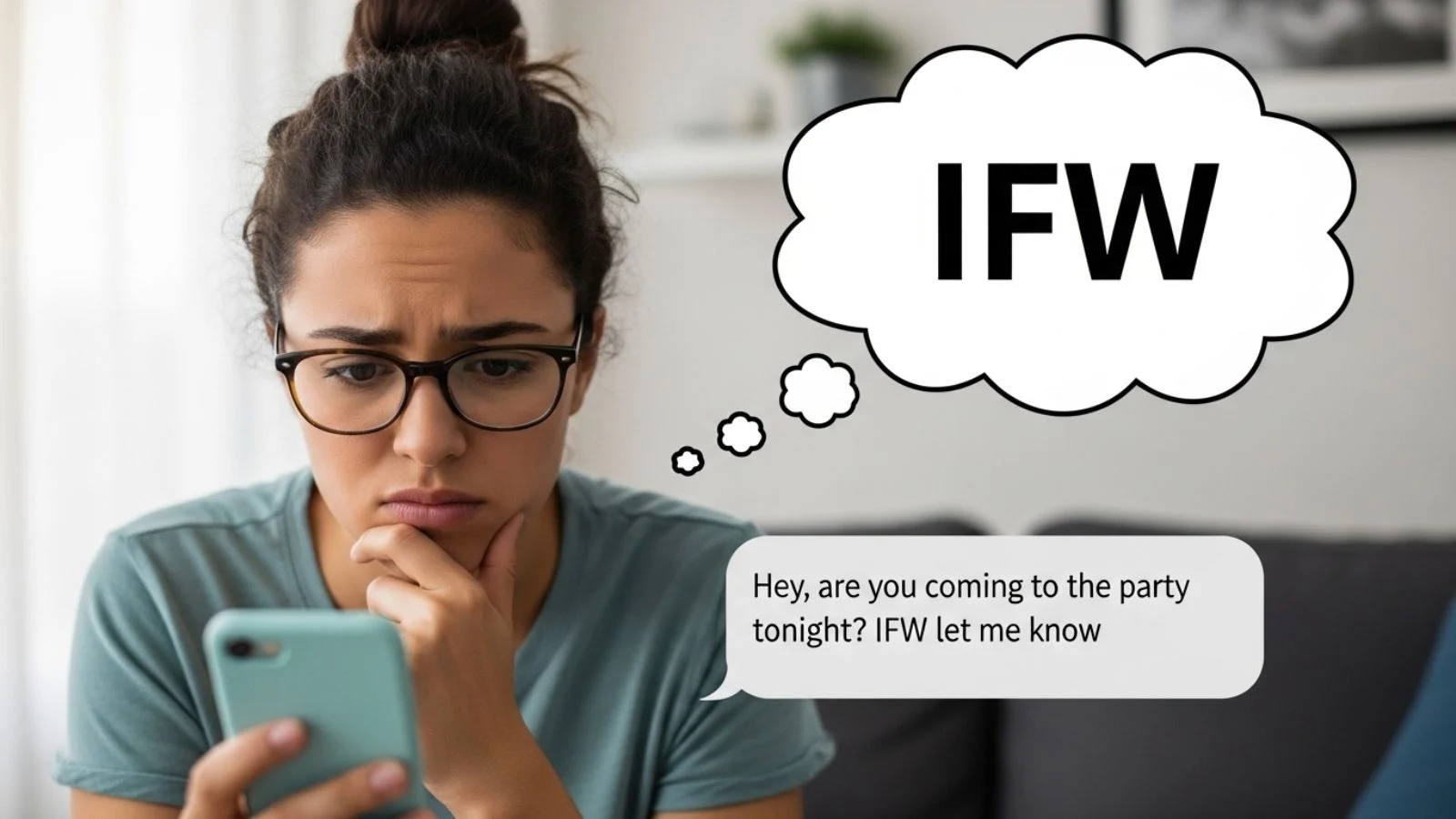
IFW means “I f*ck with,” a casual slang phrase used in text and online chat to show strong approval, support, or agreement with someone or something. It’s commonly used in informal conversations on social media and messaging apps.
If you’ve seen “IFW” in a DM, Snapchat streak, TikTok comment, or WhatsApp chat and felt confused, you’re not alone. Let’s break it down in simple terms.
IFW Meaning in Text
The IFW meaning in text is straightforward:
IFW = “I f*ck with”
In casual internet language, it means:
- I like it
- I support it
- I agree with you
- I respect that
- I’m into that
It’s an acronym made from the first letters of a longer slang phrase. Because the full phrase includes profanity, people shorten it to IFW.
What Does IFW Mean in Chat?
When someone uses IFW in chat, they usually mean:
- “I really like that.”
- “That’s cool.”
- “I support you.”
- “I vibe with this.”
Example:
A: I just started going to the gym again.
B: IFW that heavy.
Here, B means they support or approve of it.
Is IFW an Acronym or Something Else?
IFW is:
- An acronym
- A shortened slang form
- Informal internet language
- Not suitable for formal writing
It is not:
- A phonetic spelling
- A meme abbreviation (though it’s popular in meme culture)
- A typing mistake
It’s intentionally abbreviated to make the phrase less explicit and easier to type.
IFW Meaning Across Platforms
The meaning stays mostly the same, but the tone changes slightly depending on the platform.
IFW Meaning on Snapchat
On Snapchat, IFW often shows:
- Support for a friend
- Approval of a selfie
- Agreement in a private chat
Example:
A: New haircut.
B: IFW it.
Tone: Friendly and supportive.
IFW Meaning on TikTok
On TikTok, IFW is usually seen in comments.
Example:
“This song is underrated.”
“IFW this vibe.”
Tone: Expressive and trend-based. Often hype or supportive.
IFW Meaning on Instagram
On Instagram, IFW appears in:
- Comments under photos
- Story replies
- DMs
Example:
“You started your own business? IFW that.”
Tone: Encouraging and approving.
IFW Meaning on WhatsApp
On WhatsApp, it’s used more casually between close friends.
Example:
A: I’m quitting that toxic job.
B: IFW your decision.
Tone: Personal and supportive.
IFW in SMS (Text Messages)
In standard SMS texting, IFW feels more direct and bold.
Because SMS is more personal, the tone depends heavily on your relationship.
Tone & Context Variations
IFW can sound different depending on how it’s used.
1. Funny Tone
A: I ate pizza for breakfast again.
B: IFW that lifestyle.
Here it’s playful and joking.
2. Sarcastic Tone
A: I failed my test because I didn’t study.
B: IFW that logic.
This could mean the opposite — mild sarcasm.
3. Romantic Tone
A: I miss you.
B: IFW you heavy.
In romantic context, it can mean:
“I really like you.”
4. Angry Tone
A: I don’t care what they think.
B: IFW that energy.
It can sound intense or rebellious.
5. Playful Tone
A: I dyed my hair purple.
B: IFW it lowkey.
Playful, supportive, slightly teasing.
15 Real Chat Examples Using IFW
- A: That movie was fire.
B: IFW it. - A: I’m focusing on myself this year.
B: IFW that. - A: He finally apologized.
B: IFW that growth. - A: I’m learning coding.
B: IFW that heavy. - A: I deleted Instagram.
B: IFW that decision. - A: She started her own brand.
B: IFW her grind. - A: I cut off toxic friends.
B: IFW that energy. - A: I love rainy weather.
B: IFW that vibe. - A: I’m staying home tonight.
B: IFW that honestly. - A: I don’t argue anymore.
B: IFW that maturity. - A: I got promoted.
B: IFW that big time. - A: I prefer books over parties.
B: IFW that choice. - A: I’m taking a break from dating.
B: IFW that move. - A: I changed my major.
B: IFW it. - A: I love being alone sometimes.
B: IFW that peace.
Grammar & Language Role
Part of Speech
IFW functions as a verb phrase substitute.
It replaces:
“I support…”
“I like…”
“I agree with…”
Sentence Role
It usually appears:
- At the beginning of a sentence
- As a complete response
- Before a noun phrase
Examples:
- IFW that idea.
- IFW your mindset.
- IFW it.
Does It Replace a Full Sentence?
Yes.
Instead of writing:
“I really agree with what you said.”
People write:
“IFW that.”
Formal vs Informal Usage
IFW is:
- Very informal
- Slang-based
- Not workplace appropriate
- Not suitable for school essays
Tone impact:
- Casual
- Bold
- Confident
- Slightly edgy
How to Reply When Someone Says “IFW”
Your reply depends on context.
Funny Replies
- “As you should.”
- “You’ve got taste.”
- “I knew you would.”
- “Real recognizes real.”
Serious Replies
- “I appreciate that.”
- “That means a lot.”
- “Thank you for the support.”
- “Glad you feel that way.”
Flirty Replies
- “So you IFW me too?”
- “Is that so?”
- “Good. I like that.”
- “Careful, I might start IFW you back.”
Neutral Replies
- “Got it.”
- “Okay.”
- “Nice.”
- “Cool.”
Is IFW Rude or Bad?
Is IFW Rude?
Not necessarily. But it contains implied profanity in its full form.
Because of that:
- It may sound inappropriate in formal settings.
- Some people may find it too explicit.
Is It Disrespectful?
Only if used aggressively.
Example:
“IFW that nonsense.”
Tone determines respect level.
Is It a Bad Word?
The acronym itself is clean.
But since it stands for a phrase with profanity, avoid it:
- In school assignments
- In workplace emails
- With elders or authority figures
Can You Use It at Work?
No.
Stick to:
- “I agree.”
- “I support that.”
- “I like that idea.”
Who Uses IFW?
Age Group
Most common among:
- Gen Z (ages 13–26)
- Younger Millennials
Rare among older generations.
Regions
Popular in:
- United States
- UK
- Canada
- Online global culture
Social media spreads slang globally.
Most Common Platforms
- TikTok
- Snapchat
- Twitter/X
- Private DMs
Origin & Internet Culture
IFW comes from African American Vernacular English (AAVE) where “I f*ck with” meant:
- I associate with
- I respect
- I like
Over time:
- Social media shortened it to IFW
- Meme culture amplified it
- TikTok comment sections made it trend widely
There’s no single origin date, but it became mainstream around the mid-2010s.
It reflects:
- Fast typing culture
- Short-form communication
- Casual expressive slang
Comparison Table
| Term | Meaning | Formal/Informal | Tone | Popularity | Confusion Risk |
|---|---|---|---|---|---|
| IFW | I support / I like | Informal | Bold | High (Gen Z) | Medium |
| IDK | I don’t know | Informal | Neutral | Very High | Low |
| ION | I don’t | Informal | Casual | Medium | High |
| Dunno | Don’t know | Informal | Soft | Medium | Low |
| IDC | I don’t care | Informal | Cold | Very High | Low |
Real-World Usage Insight
In real chats, IFW is rarely used with strangers.
It appears most often:
- Between friends
- In hype conversations
- Under motivational posts
- When supporting bold decisions
It’s less about logic and more about vibe.
People use it to signal emotional alignment quickly without writing full sentences.
Frequently Asked Questions
What Does IFW Mean in Text Messages and Online Chat?
It means “I f*ck with,” which translates to “I like,” “I support,” or “I agree with” in casual conversation.
What Does IFW Mean on Snapchat and TikTok?
On Snapchat and TikTok, it usually shows approval, hype, or strong agreement with someone’s post, idea, or vibe.
Is IFW Rude, Disrespectful, or Harmless Slang?
It’s harmless among friends but inappropriate in professional or formal settings due to its underlying profanity.
How Should You Reply When Someone Says “IFW”?
You can reply with appreciation, humor, or flirtation depending on the situation:
- “Appreciate that.”
- “You’ve got good taste.”
- “So you IFW me too?”
Is IFW the Same as IDK or Different?
Very different.
- IFW shows approval.
- IDK means “I don’t know.”
They serve completely different purposes.
Can You Use IFW in School or Work?
Avoid it in:
- Academic writing
- Work emails
- Professional messages
It’s best reserved for casual chats.
Final Summary: When to Use IFW (And When to Avoid It)
IFW means “I f*ck with,” and it’s used to show strong approval, agreement, or support in informal text conversations.
Use IFW When:
- Talking to close friends
- Commenting on social media
- Supporting someone’s decision
- Matching casual Gen Z tone
Avoid IFW When:
- Writing professionally
- Speaking to teachers or bosses
- Communicating formally
- Messaging someone who dislikes slang
Common Mistakes
- Using it in formal emails
- Assuming everyone understands it
- Using it in serious professional contexts
IFW is vibe-based slang. It’s expressive, confident, and supportive — but only in the right setting.