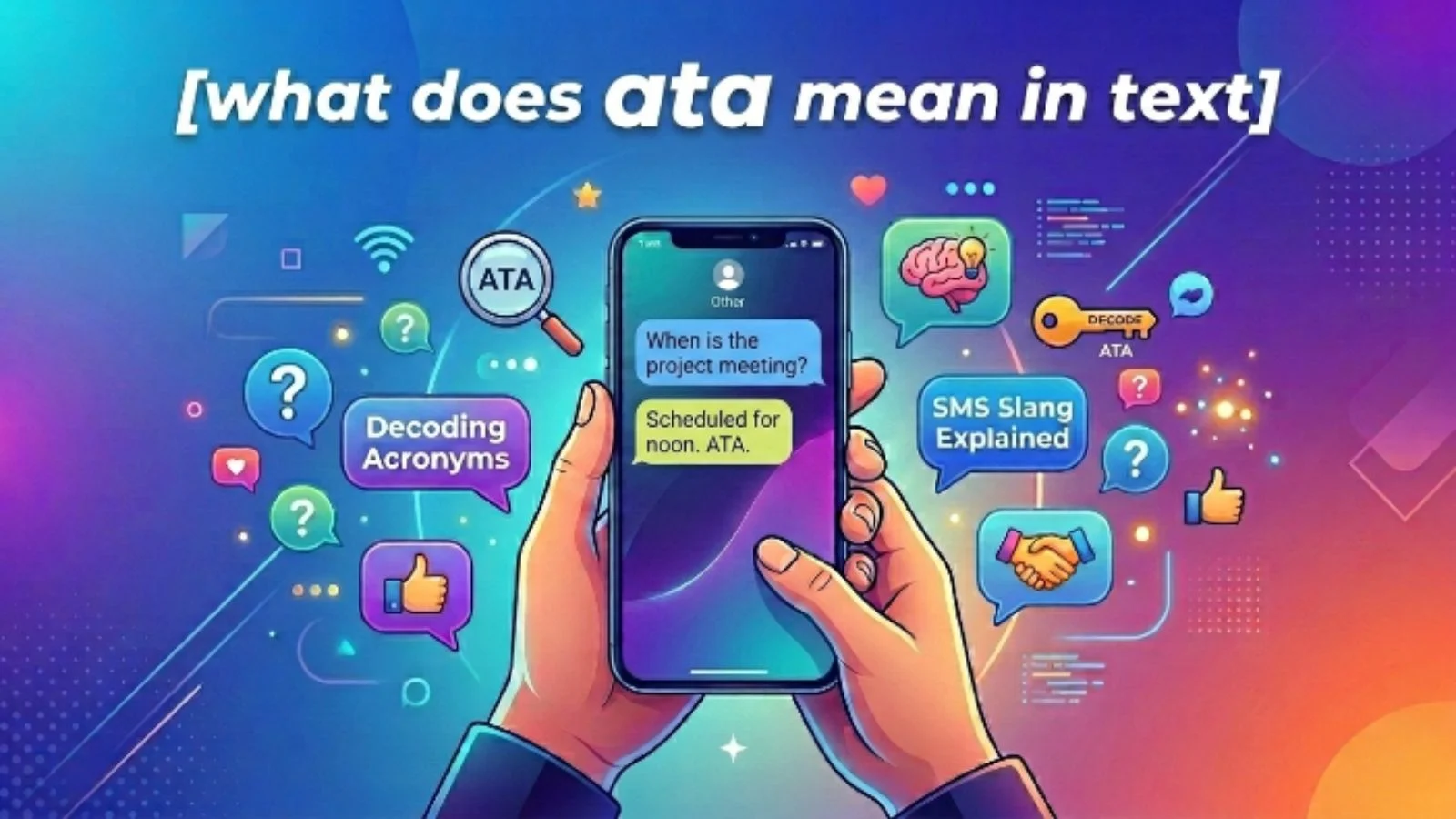
Have you ever received a text containing “ATA” and wondered what the person actually meant?
You are not alone. Unlike common texting abbreviations such as “LOL” or “BRB,” ATA does not have one universal meaning in every conversation. Its meaning depends heavily on the context in which you see it.
In texting and online communication, ATA most commonly means “Actual Time of Arrival.” It is especially useful when people are discussing travel, deliveries, transportation, meetings, or someone who is on the way.
However, ATA can have other meanings in technology, transportation, aviation, and online communities. That is why looking at the surrounding words is important.
In this guide, you will learn exactly what ATA means in text, how people use it, examples of ATA in real conversations, similar abbreviations, and how to tell which meaning applies.
What Does ATA Mean in Text?
ATA usually means “Actual Time of Arrival” in text messages and online conversations.
It refers to the real time when a person, vehicle, package, or other item actually arrives at a particular location.
For example:
“What’s the ATA of the bus?”
This means:
“What time did the bus actually arrive?”
ATA is different from ETA, which means Estimated Time of Arrival. ETA tells you when something is expected to arrive, while ATA tells you when it actually arrived.
ATA at a Glance
| Abbreviation | Meaning | What it tells you |
|---|---|---|
| ATA | Actual Time of Arrival | When something actually arrived |
| ETA | Estimated Time of Arrival | When something is expected to arrive |
| ETD | Estimated Time of Departure | When something is expected to leave |
| ATD | Actual Time of Departure | When something actually left |
So, if someone asks you for the ATA, they are generally asking about the actual arrival time.
Simple Meaning of ATA
In simple English, ATA means “the time something really arrived.”
Imagine your friend tells you:
“The train was supposed to arrive at 6:00.”
But the train actually arrives at 6:18.
The ETA was 6:00, while the ATA was 6:18.
This distinction is especially useful when plans change because of traffic, delays, weather, or other unexpected events.
ATA vs. ETA: The Easy Way to Remember
Think of it this way:
ETA = expected arrival
ATA = actual arrival
If your friend says:
“My ETA is 7:30.”
They expect to arrive at 7:30.
If they later say:
“ATA was 7:48.”
They actually arrived at 7:48.
That small difference makes ATA useful in conversations involving schedules and transportation.
Where Is ATA Used in Texting?
ATA can appear in several types of conversations.
It is particularly common when people are discussing arrival times, transportation, deliveries, or schedules.
1. Talking About Travel
You might see ATA when someone is discussing a flight, train, bus, or other journey.
For example:
“Do you know the ATA of the flight?”
The person wants to know when the flight actually arrived.
2. Discussing Deliveries
ATA can also be useful when talking about packages.
For example:
“The tracking page says it arrived. What was the ATA?”
Here, ATA refers to the actual time the package reached its destination.
3. Workplace Conversations
People may use ATA when discussing business transportation or scheduled arrivals.
For example:
“Please add the ATA to the report.”
This means the report should include the actual arrival time.
4. Casual Messages
Although ATA has a more practical or logistical meaning than many popular slang terms, people can still use it casually.
For example:
“What’s the ATA? We’re waiting for you.”
In this situation, the sender wants to know when the person actually arrived or is expected to arrive, depending on the context.
Why Do People Use ATA?
The main reason people use ATA is convenience and precision.
Instead of writing:
“What time did you actually arrive?”
someone can simply write:
“What was the ATA?”
This is particularly helpful in conversations where arrival times matter.
People may use ATA because it:
- Saves time when typing
- Makes schedules easier to discuss
- Separates actual arrival from estimated arrival
- Is useful in transportation conversations
- Works well in workplace or logistics communication
- Makes reports and messages more concise
However, ATA is not as universally understood as abbreviations such as LOL, OMG, BRB, or IDK.
That means you should consider your audience before using it.
Real-Life Examples of ATA in Text
Understanding ATA becomes much easier when you see it in actual conversations.
Example 1: Waiting for a Friend
Alex: “Are you here yet?”
Sam: “Yeah, just arrived.”
Alex: “What was your ATA?”
Sam: “7:42 PM.”
Here, ATA means the actual time Sam arrived.
Example 2: Flight Conversation
Mia: “Did your flight arrive on time?”
Noah: “Not really. The ETA was 3:15, but the ATA was 3:47.”
Here, Noah is explaining that the flight arrived later than expected.
Example 3: Delivery
Customer: “When was the package delivered?”
Support: “The ATA was 2:36 PM.”
In this example, ATA means the actual delivery arrival time.
Example 4: Bus or Train
Friend: “Did the train arrive at 8?”
You: “No. Its ATA was 8:22.”
The train arrived 22 minutes later than expected.
Example 5: Work Schedule
Manager: “Please update the shipment details.”
Employee: “Sure. I’ll include the ATA.”
Here, the employee will record the shipment’s actual arrival time.
ATA vs. Similar Texting Terms
ATA is easy to confuse with other arrival-related abbreviations.
| Term | Full Form | Meaning |
|---|---|---|
| ATA | Actual Time of Arrival | The time something actually arrived |
| ETA | Estimated Time of Arrival | The expected arrival time |
| ATD | Actual Time of Departure | The time something actually left |
| ETD | Estimated Time of Departure | The expected departure time |
ATA vs. ETA
This is the most important comparison.
ETA is about an expectation.
ATA is about what actually happened.
For example:
ETA: 5:00 PM
The person expects to arrive at 5:00 PM.
ATA: 5:27 PM
The person actually arrived at 5:27 PM.
ATA vs. ATD
These two abbreviations describe different events.
ATA = when something arrived.
ATD = when something departed.
So:
“ATA was 9:15.”
means it arrived at 9:15.
But:
“ATD was 8:40.”
means it left at 8:40.
Does ATA Mean “At the Moment”?
This is an important point because people sometimes confuse ATA with ATM.
If someone wants to say “at the moment” in texting, the common abbreviation is ATM, not ATA.
For example:
“I’m busy ATM.”
means:
“I’m busy at the moment.”
Therefore, you should not automatically interpret ATA as “at the moment.”
If the conversation is about someone’s current situation, ATM may be what the sender intended.
If the conversation is about travel or arrival, ATA is much more likely to mean Actual Time of Arrival.
Can ATA Have Other Meanings?
Yes.
One reason ATA can be confusing is that it is also used as an abbreviation in several professional and technical fields.
For example, ATA can refer to Advanced Technology Attachment in computing. It has also been used for transportation-related organizations and other technical terms.
Some slang-reference websites also list “Ait To Air” as a possible slang interpretation, although this is much less standard and should not automatically be assumed in an ordinary text conversation.
This is why context matters more than the three letters themselves.
Look at the Words Around ATA
If you see:
“ATA was 4:20 PM.”
Arrival is probably being discussed.
If you see:
“Check the ATA connection.”
You may be dealing with a technical meaning rather than texting slang.
If you see:
“What’s your ATA?”
Look at the previous messages. If the conversation is about someone traveling, Actual Time of Arrival is a strong possibility.
When Should You Use ATA?
You can use ATA when you are confident the person you’re talking to understands the abbreviation.
It works particularly well in:
- Travel conversations
- Transportation discussions
- Delivery updates
- Work messages
- Scheduling
- Logistics
- Tracking information
For casual conversations with someone who may not know the abbreviation, writing “actual arrival time” can be clearer.
For example, instead of:
“What’s your ATA?”
you could say:
“What time did you actually arrive?”
This removes any possibility of confusion.
Common Misunderstandings About ATA
Mistake 1: Assuming ATA Always Means One Thing
ATA has multiple meanings.
The context determines which definition makes sense.
Mistake 2: Confusing ATA With ETA
This is probably the easiest mistake to make.
Remember:
ETA = expected
ATA = actual
Mistake 3: Thinking ATA Means “At the Moment”
The standard texting abbreviation for “at the moment” is ATM.
ATA generally refers to something different.
Mistake 4: Treating ATA as Universal Slang
ATA is not one of the most universally recognized texting abbreviations.
Some people may immediately understand it, while others may need clarification.
If your audience is unfamiliar with transportation terminology, spelling it out may be better.
How to Understand ATA From Context
If someone sends you “ATA” and you are unsure what it means, don’t panic.
Use these clues.
If the conversation mentions:
Flights, trains, buses, cars, packages, deliveries, or arrivals
ATA probably means Actual Time of Arrival.
If the conversation mentions:
Computers, storage devices, interfaces, or technical hardware
ATA could refer to Advanced Technology Attachment.
If the conversation mentions:
Current situations or what someone is doing right now
Check whether the sender may actually mean ATM, meaning “at the moment.”
If Nothing Makes Sense
Simply ask:
“What do you mean by ATA?”
There is nothing wrong with asking for clarification. Abbreviations can have different meanings across different communities.
Pro Tips for Using ATA Correctly
1. Use context.
Never interpret ATA without looking at the surrounding conversation.
2. Know your audience.
A coworker in logistics may understand ATA immediately, while a casual friend may not.
3. Don’t confuse it with ETA.
ATA describes what actually happened; ETA describes what is expected.
4. Avoid unnecessary abbreviations.
If clarity matters, write “actual time of arrival” instead.
5. Check the platform and conversation.
A transportation group, workplace chat, gaming community, and casual text thread may use abbreviations differently.
Is ATA a Slang Word or an Abbreviation?
ATA is better described as an abbreviation or initialism than as mainstream internet slang.
In the context of texting, it can be used as shorthand for Actual Time of Arrival. Reference sources also classify this meaning as an abbreviation used in transportation and everyday communication.
That distinction matters because ATA does not have the same casual, emotional quality as slang such as “LOL,” “OMG,” or “TBH.”
It is mainly a convenient shortened form of a longer phrase.
What Does ATA Mean on Social Media?
On social media, ATA does not have one guaranteed universal meaning.
If you encounter it in a post, comment, direct message, or group conversation, examine the surrounding content.
For example, a post discussing:
“The flight finally landed. ATA: 11:35.”
clearly uses ATA to refer to Actual Time of Arrival.
But if ATA appears as part of a niche community’s terminology, it may have a completely different meaning.
This is one reason dictionary-style answers that give only one definition can sometimes be misleading.
What Should You Reply When Someone Says ATA?
Your response depends on what the person is asking.
If they say:
“What was the ATA?”
You can provide the actual arrival time:
“It arrived at 6:25 PM.”
If you are unsure what they mean, simply ask:
“Do you mean actual time of arrival?”
That is a clear and natural response.
Frequently Asked Questions
What does ATA mean in text?
ATA usually means “Actual Time of Arrival.” It refers to the time a person, vehicle, package, flight, or other item actually arrives.
What is the difference between ATA and ETA?
ATA means Actual Time of Arrival, while ETA means Estimated Time of Arrival. ETA is the expected arrival time; ATA is the actual arrival time.
Does ATA mean “at the moment”?
Usually, no. ATM is the common abbreviation for “at the moment.” ATA generally refers to Actual Time of Arrival when used in a texting or transportation context.
Is ATA commonly used in texting?
ATA can appear in texts, especially when people discuss travel, transportation, deliveries, or schedules. However, it is less universally understood than common texting abbreviations such as LOL, BRB, or IDK.
Final Thoughts
So, what does ATA mean in text?
In most arrival-related conversations, ATA means “Actual Time of Arrival.” It tells you when someone or something actually reached a destination.
The key is not to confuse it with ETA, which means Estimated Time of Arrival. ATA describes what really happened, while ETA describes what is expected to happen.
ATA can also have technical or specialized meanings, so always consider the conversation before deciding what the abbreviation means.
When you’re unsure, the safest approach is simple: look at the context or ask the sender for clarification. That will help you understand ATA correctly without making assumptions.