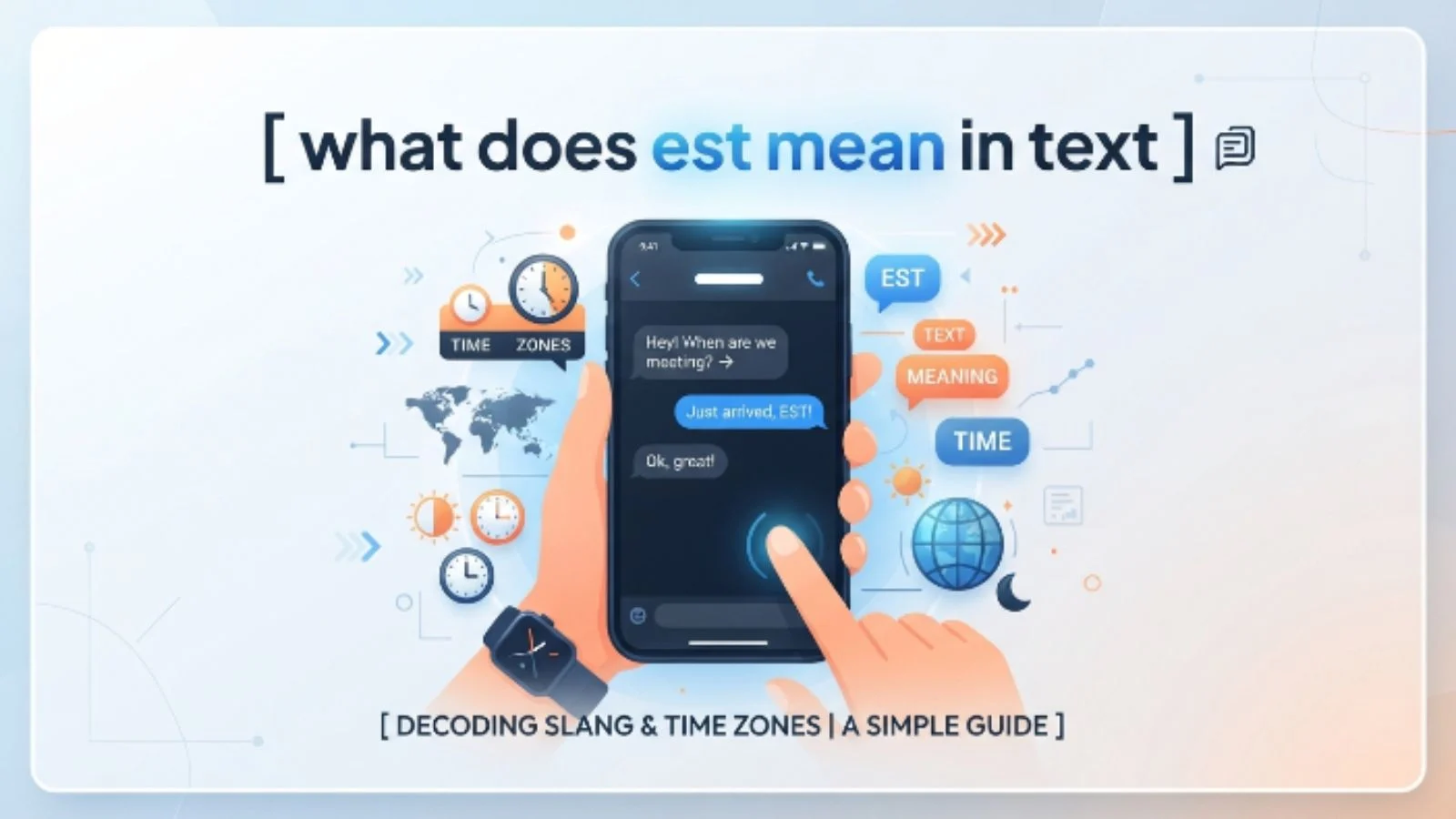
Have you ever received a message with “EST” in it and wondered what the sender actually meant?
You’re not alone. Like many internet abbreviations, EST can have different meanings depending on the conversation. In one text, it might refer to a time zone. In another, it could be part of a username, business name, or even a casual online conversation.
The good news is that understanding EST is usually easy once you know the context.
In this guide, you’ll learn what EST means in text, where people use it, why it’s common, and how to understand it correctly. We’ll also cover examples, common misunderstandings, and frequently asked questions.
What Does EST Mean in Text?
EST most commonly stands for “Eastern Standard Time.” It is used when someone is talking about time, schedules, meetings, gaming events, live streams, or deadlines.
Featured Definition
EST means “Eastern Standard Time,” the standard time used in parts of the eastern United States and Canada during the non-daylight saving months. In text messages and online conversations, people often use EST to tell others which time zone they are referring to.
However, depending on the situation, EST can also stand for other things, which is why context matters.
Simple Meaning
In simple words, EST tells you which time zone someone is talking about.
For example:
- “The meeting starts at 8 PM EST.”
- “I’ll be online around 6 EST.”
- “The game update drops at 10 AM EST.”
Instead of writing the full phrase Eastern Standard Time, people shorten it to EST because it’s quicker and everyone familiar with time zones understands it.
What Does EST Stand For?
Although Eastern Standard Time is by far the most common meaning in text conversations, EST has several other meanings depending on the topic.
Some common meanings include:
- Eastern Standard Time (most common)
- Established (often written as “Est.” in company names)
- Estimated
- Education Support Team (education)
- Engineering Science and Technology (academic fields)
When you’re chatting with friends or reading social media posts, Eastern Standard Time is almost always the intended meaning.
Where Is EST Used?
You’ll find EST across many online platforms and everyday conversations.
Text Messages
Friends often use EST when planning activities.
Example:
“Let’s play tonight at 9 PM EST.”
This lets everyone know exactly which time zone to follow.
Social Media
Content creators frequently announce events using EST.
Examples:
- Live Q&A at 7 PM EST
- Giveaway ends at midnight EST
- New video drops at 5 PM EST
Using a time zone helps followers from different countries avoid confusion.
Gaming
Gamers constantly coordinate across countries.
Example:
“Raid starts at 8 EST. Don’t be late.”
Everyone converts the time to their own location.
Online Meetings
Remote work has made time zones more important than ever.
Example:
“Our Zoom meeting begins at 10 AM EST.”
This helps international team members know when to join.
Emails
Businesses often mention EST in:
- Customer support hours
- Webinar invitations
- Product launches
- Sale deadlines
Example:
“Offer expires Friday at 11:59 PM EST.”
Why Do People Use EST?
People use EST because it removes confusion when discussing time.
Here are the biggest reasons:
- It clearly identifies the correct time zone.
- It saves space compared to writing the full phrase.
- It’s widely recognized.
- It helps people in different countries coordinate schedules.
- It reduces the chance of missing meetings or events.
Without a time zone, a message like “See you at 8 PM” could mean very different times depending on where everyone lives.
Real-Life Examples of EST in Text
Let’s look at how people naturally use EST.
Example 1
Friend:
I’ll call you around 7 PM EST.
Meaning:
The call will happen according to Eastern Standard Time.
Example 2
Gaming Group
Server maintenance starts at 4 AM EST.
Meaning:
Everyone should convert 4 AM EST into their own local time.
Example 3
Social Media Post
Live stream begins at 8 PM EST.
Meaning:
The creator is announcing the event using Eastern Standard Time.
Example 4
Work Chat
Deadline is Monday at noon EST.
Meaning:
The submission deadline follows the EST time zone.
Example 5
Online Event
Registration closes at 11:59 PM EST.
Meaning:
Anyone registering should follow the EST deadline.
EST vs Similar Terms
Many people confuse EST with other time abbreviations. Here’s an easy comparison.
| Term | Meaning | When Used |
|---|---|---|
| EST | Eastern Standard Time | Winter months |
| EDT | Eastern Daylight Time | Summer months |
| CST | Central Standard Time | Central time zone |
| MST | Mountain Standard Time | Mountain region |
| PST | Pacific Standard Time | West Coast time zone |
| GMT | Greenwich Mean Time | International reference |
| UTC | Coordinated Universal Time | Global standard |
One important thing to remember is that EST and EDT are not the same.
EST vs EDT
This is probably the biggest source of confusion.
EST
- Used during standard time.
- Usually from early November to mid-March.
EDT
- Used during daylight saving time.
- Usually from mid-March to early November.
Many people accidentally write EST all year, even when they technically mean EDT.
When Should You Use EST?
You should use EST whenever you’re talking about a time that specifically follows Eastern Standard Time.
Good situations include:
- Scheduling meetings
- Planning gaming sessions
- Announcing livestreams
- Sharing event times
- Discussing deadlines
- Booking appointments
Examples:
- “Interview starts at 9 AM EST.”
- “Sale ends tonight at midnight EST.”
- “See you at 7 EST.”
When Should You Avoid Using EST?
Avoid using EST when:
- You’re talking with people in the same local area who already know the time.
- The event uses another time zone.
- Daylight saving time means the correct abbreviation is actually EDT.
If you’re unsure, writing the full time zone can make your message clearer.
Common Misunderstandings
People often misunderstand EST in a few ways.
Thinking EST Has Only One Meaning
While Eastern Standard Time is the most common meaning, EST can also mean:
- Established
- Estimated
- Various organization names
Always read the surrounding conversation.
Confusing EST With EDT
Many people use EST throughout the year.
Technically:
- Winter = EST
- Summer = EDT
This is one of the most common mistakes online.
Assuming Everyone Knows Your Time Zone
If you simply say:
I’ll be there at 8.
People in different countries won’t know which 8 you mean.
Adding EST makes your meaning much clearer.
Pro Tips for Understanding EST
Here are a few practical tips.
Always Look at Context
Ask yourself:
- Are people discussing a meeting?
- Is there a deadline?
- Is someone announcing a livestream?
If yes, EST almost certainly refers to Eastern Standard Time.
Convert the Time
If you live outside the eastern part of North America, convert EST into your own local time before joining an event.
Check for Daylight Saving Time
Sometimes the sender writes EST even though they actually mean EDT.
Double-check if the event takes place during daylight saving months.
Don’t Guess
If you’re unsure which meaning is intended, simply ask.
For example:
“Do you mean Eastern Standard Time?”
A quick question prevents missed meetings.
Is EST Common in Text Messages?
Yes.
EST is extremely common in:
- Text messages
- Discord chats
- Online gaming
- Twitch streams
- YouTube announcements
- Business emails
- Remote work communication
- Social media posts
As online communication becomes more global, abbreviations like EST help everyone stay synchronized.
Why Context Matters
One reason internet abbreviations can be confusing is that many have multiple meanings.
For example:
“EST” in these sentences means different things:
Meeting starts at 9 AM EST.
Here it means Eastern Standard Time.
Company est. 1998.
Here est. means established.
Delivery time is est. 3 days.
Here est. means estimated.
The surrounding words tell you which meaning is correct.
Final Thoughts
If you’ve been wondering what does EST mean in text, the answer is usually simple.
In most conversations, EST stands for Eastern Standard Time, helping people coordinate meetings, events, livestreams, gaming sessions, and deadlines across different locations.
Although EST has a few other meanings, they’re much less common in everyday texting. By paying attention to the context, you’ll usually understand exactly what the sender means.
The next time someone texts, “See you at 8 PM EST,” you’ll know they’re talking about the time zone—not internet slang.
Frequently Asked Questions
What does EST mean in a text message?
Most of the time, EST means Eastern Standard Time, which is used to tell people the exact time zone for a meeting, event, or conversation.
Does EST always mean Eastern Standard Time?
No. Although that’s the most common meaning in texting, EST can also mean established or estimated, depending on the context.
What’s the difference between EST and EDT?
EST is used during standard time, while EDT is used during daylight saving time. They represent different clock times during different parts of the year.
Is EST still commonly used online?
Yes. EST is widely used in text messages, social media, gaming communities, business emails, livestream announcements, webinars, and virtual meetings to avoid confusion about event times.