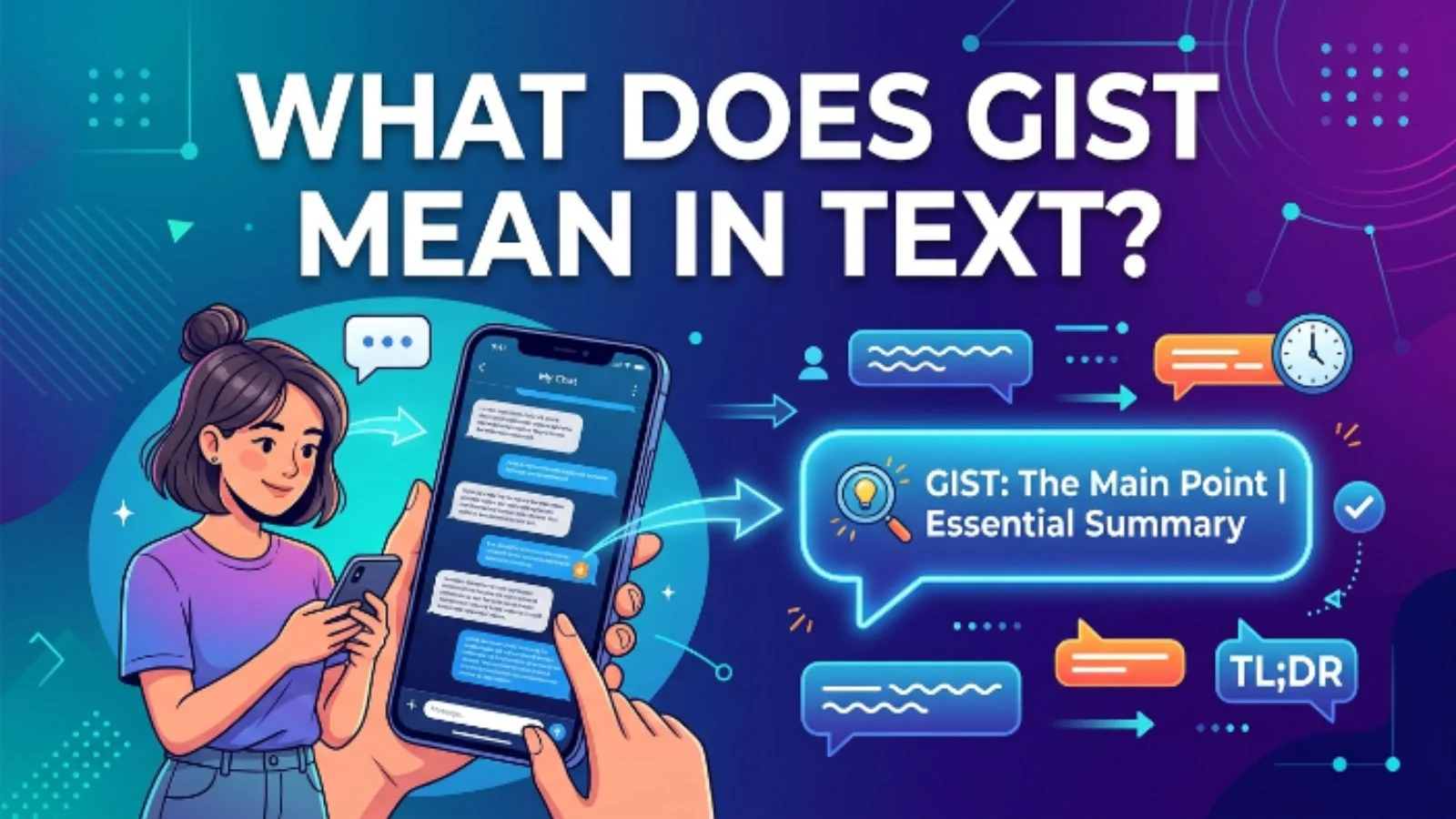
Have you ever received a message saying, “Can you give me the gist?” or “What’s the gist of it?” If you weren’t sure what it meant, you’re not alone.
The word gist is commonly used in text messages, emails, social media, and everyday conversations. It helps people ask for or share the main idea without going into every small detail.
In this guide, you’ll learn what does gist mean in text, when to use it, where it comes from, real-life examples, common mistakes, and the difference between gist and similar words. By the end, you’ll know exactly how to use it naturally in your own conversations.
What Does Gist Mean in Text?
Gist in text means the main idea, the most important points, or a brief summary of something.
Featured Snippet Definition
What does gist mean in text?
In text messages, gist means the main point or general meaning of something. When someone asks for “the gist,” they want a quick summary instead of every detail.
For example:
Friend: “I missed the meeting. Can you give me the gist?”
You: “Sure. The project deadline moved to next Friday.”
Here, the friend only wants the important information, not a full explanation.
Simple Meaning of Gist
In very simple words, gist means the main message.
Think of it like this:
- Reading an entire book = Every detail
- Knowing the gist = Understanding what the book is mostly about
The same idea applies to texting.
Instead of writing a long message, people often share only the gist.
Some easy ways to think about it are:
- Main idea
- Quick summary
- Key point
- Basic meaning
- Important information
Where Is Gist Used?
The word gist isn’t limited to texting. You’ll see it in many everyday situations.
Text Messages
People use it when they want a quick explanation.
Example:
“I wasn’t there. What’s the gist?”
Social Media
Someone may ask for the gist of a long discussion or viral post.
Example:
“Can someone give me the gist of this drama?”
Emails
Busy professionals often ask for the gist before reading a lengthy email.
Example:
“Just send me the gist before our meeting.”
School and College
Students use it while studying.
Example:
“Can you explain the gist of this chapter?”
Workplace
Managers and coworkers frequently use the word.
Example:
“What’s the gist of today’s client meeting?”
Why Do People Use Gist?
People use gist because it saves time.
Instead of reading pages of information, you only learn the most important parts.
Common reasons include:
- Saving time
- Getting quick updates
- Understanding long conversations
- Summarizing information
- Avoiding unnecessary details
- Making communication faster
In today’s fast-moving digital world, people often prefer short, clear messages over long explanations.
Examples of Gist in Text Messages
Let’s look at some real-life examples.
Example 1
Alex: “Did you finish watching the movie?”
Sam: “No. Just tell me the gist.”
Meaning: Sam only wants the basic story.
Example 2
Emma: “I missed today’s lecture.”
Jake: “The gist is that the exam has been postponed.”
Meaning: Jake shares only the important update.
Example 3
Sarah: “There were over 300 messages in the group.”
Lily: “Can you give me the gist?”
Meaning: Lily wants a short summary.
Example 4
David: “What’s the gist of the article?”
Anna: “It’s mainly about protecting your online privacy.”
Meaning: Anna explains the central idea.
Example 5
Mark: “What happened during the meeting?”
Lisa: “The gist is that we’re launching next month.”
Meaning: Lisa skips unnecessary details.
What Does “Give Me the Gist” Mean?
This is one of the most common expressions.
When someone says:
“Give me the gist.”
They mean:
- Tell me the important part.
- Summarize it.
- Skip the extra details.
- Explain it briefly.
For example:
“I don’t have time to read everything. Just give me the gist.”
What Does “I Get the Gist” Mean?
Another common phrase is:
“I get the gist.”
This means:
- I understand the main idea.
- I understand enough.
- I know what you’re talking about.
Example:
“You don’t need to explain anymore. I get the gist.”
What Does “That’s the Gist” Mean?
Sometimes people end a conversation by saying:
“That’s the gist.”
It means:
- That’s the basic idea.
- That’s the summary.
- That’s the important part.
Example:
“We’ll finish the project next week, and everyone has new tasks. That’s the gist.”
Gist vs Similar Terms
| Word | Meaning | When to Use |
|---|---|---|
| Gist | Main idea | Everyday conversations and texts |
| Summary | Short version with key details | Articles, reports, school work |
| Overview | General explanation | Presentations and introductions |
| Conclusion | Final result or ending | Essays and reports |
| Key Point | Most important fact | Meetings and discussions |
| Recap | Review of previous events | Sports, TV shows, meetings |
Although these words are similar, gist usually refers to understanding the overall meaning rather than listing every important detail.
Is Gist a Slang Word?
No.
Gist is not internet slang.
It is a real English word that has existed for hundreds of years.
However, it has become very popular in texting because people prefer short and efficient communication.
Is Gist Formal or Informal?
The good news is that gist works in both formal and informal situations.
Informal
- Texting friends
- Family chats
- Social media
Example:
“What’s the gist?”
Formal
- Business emails
- Office meetings
- Academic discussions
Example:
“Please provide the gist of the report before tomorrow’s meeting.”
When Should You Use Gist?
You can use gist whenever only the important information matters.
Good situations include:
- Long conversations
- News articles
- Books
- Movies
- School lessons
- Work meetings
- Podcasts
- Videos
- Presentations
- Group chats
It’s especially useful when you’re short on time.
When Should You Avoid Using Gist?
Sometimes a quick summary isn’t enough.
Avoid using only the gist when:
- Legal documents require full reading.
- Medical instructions contain important details.
- Contracts need careful review.
- Safety instructions must be followed completely.
- Exams require detailed understanding.
In these situations, reading the full information is much safer.
Common Misunderstandings About Gist
Many people misunderstand this word.
Here are the most common mistakes.
Mistake 1: Thinking Gist Means Every Detail
Wrong.
Gist only includes the main idea.
Mistake 2: Thinking It’s Only Used in Texting
False.
People use it in:
- Books
- Meetings
- Emails
- Schools
- Newspapers
- Everyday conversations
Mistake 3: Believing It’s Slang
It’s actually a standard English word.
Mistake 4: Confusing Gist with Opinion
The gist tells you what something is mainly about.
It doesn’t necessarily include personal opinions.
Pro Tips for Using Gist Correctly
Follow these simple tips.
Keep it short
A gist should be brief.
Focus on the main idea
Don’t include unnecessary details.
Make it easy to understand
Use simple language.
Match your audience
Friends may prefer casual wording.
At work, use professional language.
Double-check accuracy
Even a short summary should still be correct.
Common Sentences Using Gist
Here are some natural examples.
- “Can you give me the gist?”
- “I already get the gist.”
- “That’s basically the gist.”
- “I understand the gist of the conversation.”
- “What’s the gist of the movie?”
- “Tell me the gist before I read the full article.”
- “I only need the gist.”
- “She explained the gist in two minutes.”
Synonyms of Gist
Depending on the situation, you can also use:
- Main idea
- Summary
- Key point
- Core message
- Main point
- Overall meaning
- Outline
- Overview
- Basic idea
- Essential information
These words are similar, although each has slightly different uses.
Why Gist Is So Popular Today
Modern communication is fast.
People receive hundreds of emails, texts, and notifications every day.
Instead of reading everything, many people simply ask for the gist.
It helps save time while still understanding the most important information.
That’s why the word appears so often in:
- Messaging apps
- Workplace chats
- Online forums
- Video comments
- News discussions
- Group conversations
Its popularity continues to grow because it perfectly fits today’s quick communication style.
Final Thoughts
If you’ve ever wondered what does gist mean in text, the answer is simple: it refers to the main idea or a brief summary of something.
Whether you’re chatting with friends, reading emails, attending meetings, or catching up on a long conversation, asking for the gist is an easy way to understand the important information without getting lost in every detail.
Learning this common expression can make your conversations smoother and help you communicate more naturally in both casual and professional settings. The next time someone asks, “Can you give me the gist?” you’ll know they’re simply asking for the key points.
Frequently Asked Questions
What does gist mean in texting?
In texting, gist means the main idea or a short summary of a conversation, story, article, or event.
Is gist a slang word?
No. Gist is a standard English word, not internet slang, although it is commonly used in text messages and online conversations.
What does “give me the gist” mean?
It means tell me the important points without explaining every detail.
Can I use gist in professional emails?
Yes. Gist is appropriate in professional communication when asking for or providing a brief summary of information.