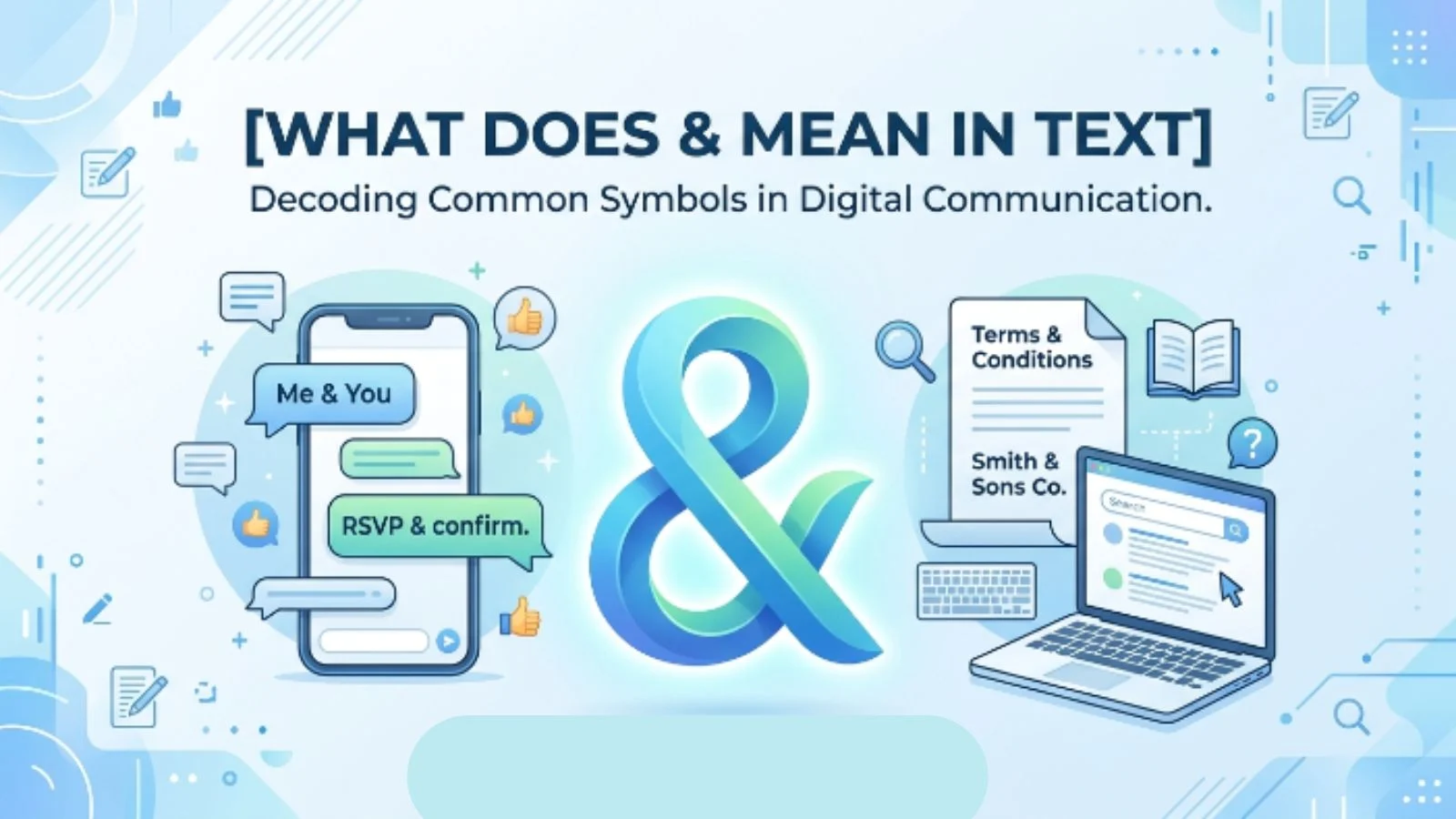
Have you ever been scrolling through your phone, reading a fast-paced text from a friend, and stumbled across a little symbol that looks like a tangled knot or a stylized number eight? You know the one: &.
While you might instinctively know it has something to do with connecting words, seeing it pop up mid-text can sometimes make you pause. Is it a typo? Is it a secret shortcut? Does it change the vibe of the message?
In the fast-moving world of digital communication, every character counts. People are constantly looking for ways to type faster, convey meaning instantly, and keep the conversation flowing. Let’s break down exactly what this little symbol means, why it’s clogging up your chat history, and how you can use it like a pro.
What Does & Mean in Text?
In text messages and online chat, the & symbol is a shorthand abbreviation for the word “and.”
Known formally as an ampersand, this symbol serves as a direct replacement for the three-letter word “and” to save space, reduce typing time, and create a casual, fast-paced tone in digital conversations.
The Quick Definition: When you see & in a text, on social media, or in a casual caption, simply read it as “and.” It has no hidden double meaning or secret slang definition; it is purely a tool for speed and brevity.
The Simple Meaning of the Ampersand
To put it in the simplest terms possible, the ampersand is a visual shortcut.
Think about how often you type the word “and” in a single day. It is one of the most frequently used words in the English language. When you are typing on a tiny smartphone keyboard with your thumbs, hitting three separate keys (a, n, and d) plus a spacebar takes a noticeable amount of effort compared to hitting a single symbol.
Historically, the symbol itself is a visual blend of the letters E and t, which spell et—the Latin word for “and.” Over centuries of handwriting and typing, those two letters fused together into the symbol we recognize today. In modern texting, it has stripped away all its ancient formality to become the ultimate lazy-typing companion.
Where Is It Used Most Often?
While you can technically use the ampersand anywhere, it dominates specific platforms and situations due to how we interact with our screens.
1. SMS and Fast-Paced Direct Messaging
When you are firing off a quick update to a partner or a roommate, speed is everything. You are likely trying to text while walking, cooking, or multitasking. Dropping an ampersand keeps your thumbs moving forward without interruption.
2. Social Media Platforms with Character Limits
Platforms like Twitter (X) have taught us to be incredibly protective of our character counts. When you are running out of space to finish a thought, replacing three characters (“and”) with one (“&”) can give you the exact real estate you need to fit your entire message into a single post.
3. Group Chats
In a fast-moving group text where five people are typing at once, you need to get your point across before the topic changes. Using shortcuts helps you drop your input into the chat at lightning speed.
4. Professional but Casual Digital Workspaces
In apps like Slack, Microsoft Teams, or Discord, work moves fast. Colleagues frequently use the ampersand in project titles, quick updates, or bullet points to make notes look cleaner and easier to read at a glance.
Why Do People Use & in Text Messages?
It might seem trivial to save just two keystrokes, but people use the ampersand for several distinct reasons that go beyond basic laziness.
- Visual Structure: A symbol breaks up blocks of text. When your eye scans a sentence, seeing a symbol makes it easier to separate two distinct ideas than reading a continuous wall of lowercase letters.
- Creating Pairs: The ampersand is incredibly efficient at linking two things that belong together as a unit. It acts like a piece of glue for concepts.
- Aesthetic Vibe: Let’s face it—sometimes text looks more casual, modern, or visually appealing when you use a symbol instead of formal words. It signals to the reader that the conversation is relaxed and informal.
Real-Life Examples of & in Action
To see how this looks in everyday life, let’s look at a few common texting scenarios and translate exactly how they read.
Example 1: The Logistics Text
- The Text: “Hey, can you grab milk & eggs on your way home?”
- The Meaning: “Hey, can you grab milk and eggs on your way home?”
- Why it’s used: The sender is likely busy and sending a quick grocery checklist. The symbol neatly separates the two items on the list.
Example 2: The Status Update
- The Text: “Movie was great, sitting in traffic now & bored out of my mind.”
- The Meaning: “The movie was great, I am sitting in traffic now and I am bored out of my mind.”
- Why it’s used: It connects two different thoughts (the movie review and the current traffic situation) without making the sentence feel too long or clunky.
Example 3: The Invitation
- The Text: “Dinner & drinks tonight around 7?”
- The Meaning: “Would you like to go out for dinner and drinks tonight around 7:00 PM?”
- Why it’s used: “Dinner & drinks” is a classic phrasing where the two activities are treated as a single package deal. The ampersand binds them together perfectly.
& vs. Similar Texting Shortcuts
The ampersand isn’t the only way people shorten their sentences. Depending on who you are texting and how fast you are moving, you might see other variations. Here is how they stack up against each other:
| Shortcut | What It Stands For | Tone & Vibe | Best Used For |
| & | And | Casual, clean, universally understood | Linking pairs, lists, and fast updates |
| n | And | Ultra-casual, youthful, slightly lazy | Rock ‘n’ roll style phrases, very informal chats |
| + | Plus / And | Analytical, mathematical, additive | Adding an extra thought or item at the end |
| w/ | With | Functional, practical, old-school | Saving space when describing companions or additions |
When Should You Use It (and When Should You Avoid It)?
Using text shortcuts is all about reading the room. While the ampersand is highly versatile, it isn’t always appropriate.
When to use it:
- In casual texts with friends, family, and peers.
- In social media captions, bios, and tweets.
- In quick notes to self or digital grocery lists.
- In informal work chats with close teammates.
When to avoid it:
- Formal emails: If you are writing to a professor, a hiring manager, or a new client, type out the full word “and.” Using symbols can make your writing look rushed or unprofessional.
- Cover letters and resumes: Standard rules of grammar apply here. Keep it strictly formal.
- Apologies or serious conversations: When dealing with heavy emotional topics over text, shortcuts can accidentally make you look detached or insincere. Take the time to spell out your words to show you are fully invested in the conversation.
Common Misunderstandings About the Ampersand
Because digital culture moves incredibly fast, people often look for hidden meanings where they don’t exist. Let’s clear up a few misconceptions about using & in your chats.
Is it angry or passive-aggressive?
No. Unlike using all capital letters (WHICH FEELS LIKE SHOUTING) or ending a text with a single, cold period, the ampersand carries zero emotional malice. It is a neutral, functional symbol meant for efficiency.
Does it mean something different in dating or flirting?
Not explicitly. However, if someone texts you “you & me,” they are using the symbol to create a sense of close partnership and connection. It sounds a bit more intimate and deliberate than typing out “you and me.”
Is it considered bad grammar?
In a formal essay? Yes. In a text message? Absolutely not. Texting has its own set of linguistic rules where clarity and speed take priority over traditional textbook grammar.
Pro Tips for Using & Like a Digital Native
If you want to incorporate the ampersand into your daily digital routine without looking clunky, keep these simple guidelines in mind:
- Mind your spacing: Always put a space before and after the symbol (e.g., “bacon & eggs,” not “bacon&eggs”). Leaving out spaces makes the text look cluttered and harder to read.
- Don’t overdo it: If you have a long text paragraph, try not to use five ampersands in a row. Mix it up with regular words so your message doesn’t look like a string of computer code.
- Use it for natural pairs: It works best when linking things that naturally go together, like “sweet & sour,” “rock & roll,” or “peace & quiet.”
Final Thoughts
At the end of the day, text communication is all about expressing yourself clearly with the least amount of friction. The & symbol is a timeless tool that made the jump from ancient stone carvings straight into our pocket screens for one simple reason: it works.
The next time you see it in a text, you can read right through it without a second thought. And if you are looking to shave a fraction of a second off your own typing speed, go ahead and start dropping it into your own daily chats.
Frequently Asked Questions
What does & mean from a guy or girl in a text?
It simply means “and.” It does not indicate attraction, anger, or hidden motives. It just means the person typing is trying to send their message quickly.
What is the actual name of the & symbol?
The official name for the & symbol is the ampersand. The word comes from a historical phrase “and per se and,” which basically meant “the symbol that stands for and.”
Is it okay to use & in an email?
If the email is to a close colleague or teammate on an internal project, it is usually fine. If the email is formal, external, or sent to an authority figure, it is always safer to spell out the word “and.”
Where is the & symbol on a standard phone keyboard?
On most iPhone and Android keyboards, you can find it by tapping the 123 or ?123 button to open the numbers and symbols screen. It is typically located in the top or middle row of that secondary screen.