If you’ve been scrolling through social media or chatting with friends, you may have seen someone post QOTD and wondered what it means.
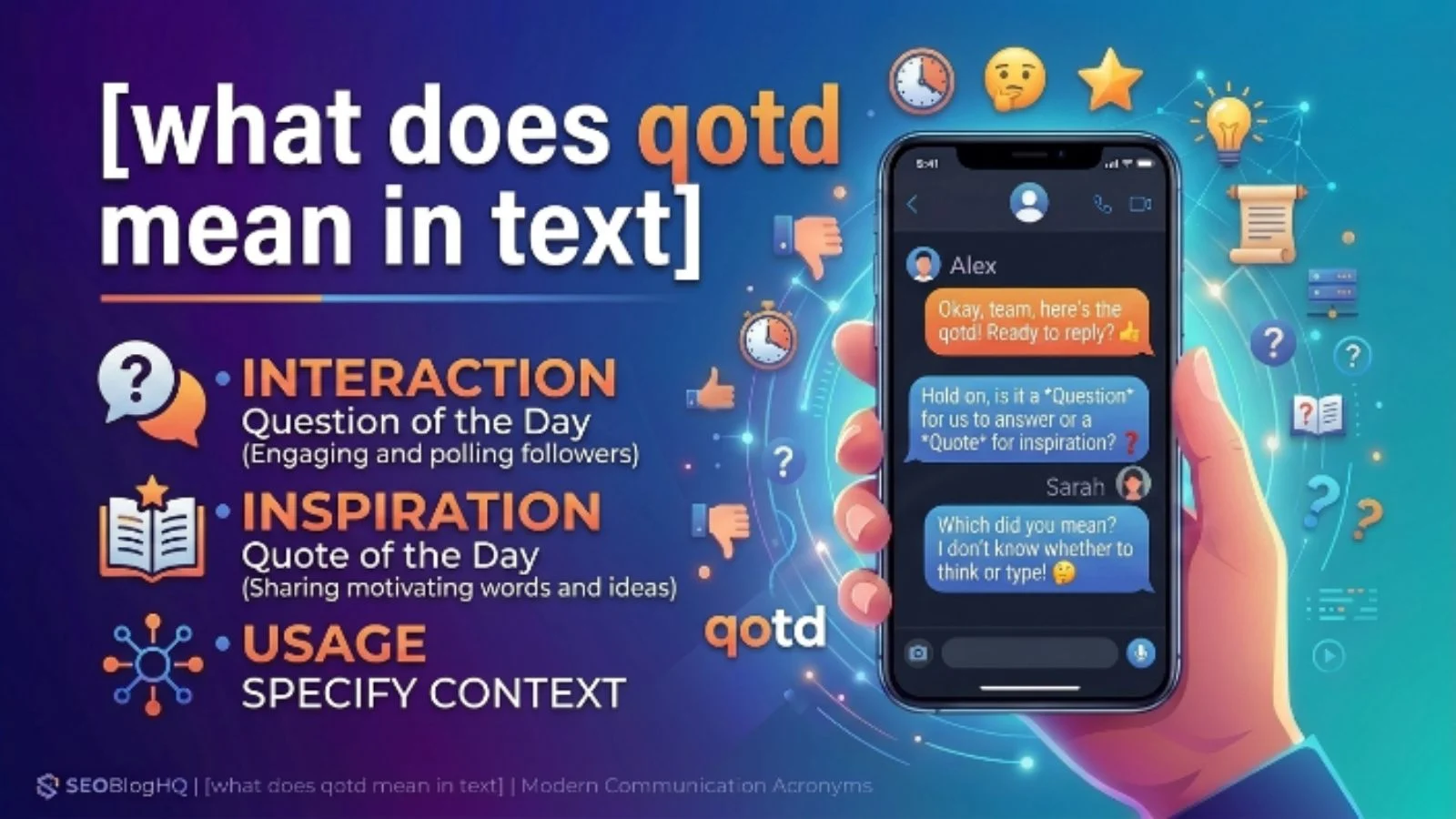
QOTD stands for Question of the Day.
People use it to ask one interesting question every day. The goal is to start conversations, encourage people to share opinions, or simply have fun.
For example, someone might post:
QOTD: If you could travel anywhere in the world, where would you go?
Everyone can reply with their own answer.
Today, QOTD is widely used on TikTok, Instagram, Snapchat, Facebook, X (formerly Twitter), Discord, Reddit, and messaging apps. It is one of the easiest ways to increase engagement and keep conversations active.
Quick Answer
| Term | Meaning |
|---|---|
| QOTD | Question of the Day |
| Used On | Text messages, social media, forums, Discord, classrooms |
| Purpose | Start conversations and encourage replies |
| Tone | Friendly, fun, interactive |
| Popular In | TikTok, Instagram Stories, Snapchat, Facebook Groups, online communities |
What Does QOTD Mean in Simple Words?
In simple English:
QOTD means asking everyone the same question on that day.
It gives people something interesting to answer.
Think of it like a daily conversation starter.
Examples include:
- QOTD: What’s your favourite movie?
- QOTD: Coffee or tea?
- QOTD: What skill do you want to learn this year?
Each person answers differently.
Full Form of QOTD
QOTD = Question Of The Day
Breaking it down:
- Q = Question
- O = Of
- T = The
- D = Day
It simply means today’s featured question.
Origin and History of QOTD
The phrase Question of the Day existed long before social media.
Teachers often used a “Question of the Day” in classrooms to help students think and improve communication skills.
Later, online forums adopted the idea.
As texting became popular, people shortened it to QOTD.
By the late 2010s and early 2020s, creators on social media started using QOTD daily to increase comments and engagement.
By 2026, QOTD has become common across:
- TikTok
- Instagram Stories
- Snapchat
- Discord servers
- Reddit communities
- YouTube Community posts
- Classroom learning apps
- Team communication platforms
Why Do People Use QOTD?
People use QOTD for many reasons.
Some want to entertain followers.
Others want to learn about their audience.
Many simply enjoy starting conversations.
Common reasons include:
- Breaking the ice
- Starting discussions
- Increasing social media engagement
- Learning opinions
- Building online communities
- Creating daily content
- Encouraging classroom participation
Where Is QOTD Used?
You’ll find QOTD almost everywhere online.
In Text Messages
Friends may ask:
QOTD: What’s your dream job?
Everyone replies with their answer.
On Instagram
Creators often post a daily QOTD in Stories.
Example:
QOTD: Beach vacation or mountain vacation?
Followers vote or reply.
On TikTok
Many creators begin videos with:
Today’s QOTD…
They then invite viewers to comment.
On Snapchat
People post quick questions like:
QOTD: What’s your biggest pet peeve?
Friends respond privately or publicly.
In Schools
Teachers ask daily questions such as:
QOTD: What makes a good friend?
Students discuss their ideas.
At Work
Teams sometimes begin meetings with:
QOTD: What’s one goal for today?
This helps everyone participate.
Real-Life Examples of QOTD
Here are common examples.
Example 1
Sarah posts:
QOTD: What’s your favourite pizza topping?
Friends answer:
Pepperoni.
Cheese.
Mushrooms.
Explanation: Everyone shares a personal preference.
Example 2
A teacher writes:
QOTD: What would you invent to help people?
Students write creative answers.
Explanation: The question encourages imagination.
Example 3
A YouTuber asks:
QOTD: Which video should I make next?
Subscribers vote.
Explanation: The creator collects ideas from viewers.
Example 4
Friend:
QOTD: Cats or dogs?
You:
Dogs because they’re playful.
Explanation: You simply answer today’s question.
Example 5
Gaming group:
QOTD: Which game deserves a remake?
Members discuss their favourite games.
Explanation: QOTD starts an active conversation.
Short Dialogues Using QOTD
Dialogue 1
Ali:
QOTD: What’s your favourite season?
Ahmed:
Winter.
Ali:
Same here.
Explanation: A simple daily conversation.
Dialogue 2
Emma:
QOTD: What’s one country you want to visit?
John:
Japan.
Emma:
Great choice.
Explanation: The question helps people learn about each other.
Dialogue 3
Teacher:
QOTD: What’s kindness?
Student:
Helping people.
Teacher:
Excellent answer.
Explanation: QOTD encourages learning.
Different Types of QOTD
Not every Question of the Day is the same.
Some are fun.
Some are educational.
Some are personal.
Common categories include:
Fun QOTD
- Pizza or burgers?
- Summer or winter?
- Dogs or cats?
School QOTD
- What’s photosynthesis?
- Why do we recycle?
- What is honesty?
Relationship QOTD
- What’s your love language?
- What makes a good friend?
- What’s the best date idea?
Gaming QOTD
- Best multiplayer game?
- Console or PC?
- Favourite gaming character?
Business QOTD
- What’s your productivity tip?
- Which leadership skill matters most?
- What’s your biggest work challenge?
Personal Growth QOTD
- What’s one goal this month?
- What’s something new you learned?
- What’s your biggest achievement?
Personality Traits Behind People Who Use QOTD
People who regularly post QOTD often enjoy conversations.
Common personality traits include:
- Friendly
- Curious
- Creative
- Social
- Open-minded
- Interactive
- Good communicators
- Community builders
This doesn’t describe everyone, but these traits are common among people who enjoy asking daily questions.
How to Reply to a QOTD
Replying is easy.
Simply answer honestly.
Examples:
Question:
QOTD: What’s your favourite colour?
Reply:
Blue.
Question:
QOTD: Morning or night?
Reply:
Night because I’m more productive.
Question:
QOTD: What’s one food you could eat forever?
Reply:
Pizza.
QOTD on Different Social Media Platforms (2026)
| Platform | How QOTD Is Used |
|---|---|
| TikTok | Video discussions |
| Stories and polls | |
| Snapchat | Daily questions |
| Group engagement | |
| Discord | Community chats |
| Discussion threads | |
| X | Conversation starters |
| YouTube | Community posts |
Why Influencers Love QOTD
Influencers use QOTD because it:
- Increases comments
- Builds community
- Creates daily content
- Helps understand followers
- Encourages discussion
- Improves engagement naturally
Modern QOTD Examples (Updated for 2026)
Today’s popular QOTDs include:
- What’s one AI tool you use every day?
- Would you rather work remotely forever?
- Which streaming show deserves another season?
- What’s your favourite productivity app?
- What’s one habit that changed your life?
- What’s your dream travel destination?
- Which game are you currently playing?
- What’s one skill everyone should learn?
These topics reflect current trends while encouraging thoughtful responses.
Common Mistakes About QOTD
Many beginners misunderstand QOTD.
Here are the most common mistakes.
Mistake 1
Thinking QOTD is a secret code.
Reality: It simply means Question of the Day.
Mistake 2
Thinking it has only one correct answer.
Reality: Everyone can answer differently.
Mistake 3
Using QOTD without asking a question.
Reality: A QOTD should always include a question.
Mistake 4
Confusing QOTD with Quote of the Day.
Some people use QOTD to mean Quote of the Day, but Question of the Day is the more common meaning in texting and social media. The intended meaning usually becomes clear from the context.
Tips for Writing a Good QOTD
If you want people to reply, keep your question:
- Short
- Easy to answer
- Interesting
- Positive
- Open-ended when possible
- Relevant to your audience
Good example:
QOTD: What’s one book everyone should read?
Less engaging example:
QOTD: Explain every detail about your life.
Simple questions usually receive more responses.
Similar Internet Abbreviations
Here are some abbreviations often seen alongside QOTD.
| Abbreviation | Meaning |
|---|---|
| QOTD | Question of the Day |
| POTD | Photo of the Day |
| WDYT | What Do You Think? |
| AMA | Ask Me Anything |
| IMO | In My Opinion |
| FYI | For Your Information |
| TBT | Throwback Thursday |
| Q&A | Question and Answer |
When Should You Use QOTD?
QOTD works well when you want to:
- Start conversations
- Increase engagement
- Learn opinions
- Build friendships
- Teach students
- Grow online communities
- Keep social media active
When Should You Avoid Using QOTD?
Avoid using QOTD when:
- The discussion is very serious.
- The question could invade someone’s privacy.
- You need a quick yes/no response instead of open discussion.
- The topic may make people uncomfortable.
Always consider your audience before posting.
Frequently Asked Questions
What does QOTD mean in text messages?
QOTD means Question of the Day. It introduces a daily question that invites others to reply with their thoughts or opinions.
Is QOTD used only on social media?
No. People also use QOTD in classrooms, workplaces, online forums, group chats, and messaging apps.
Can QOTD have different meanings?
Yes. Occasionally, some people use it to mean Quote of the Day, but in texting and most social media conversations, Question of the Day is the more common meaning.
How do you answer a QOTD?
Simply respond to the question honestly. There is usually no right or wrong answer because QOTDs ask for opinions or personal experiences.
Why do creators post QOTD every day?
Daily questions encourage followers to comment, interact, and return regularly, helping build an active and engaged community.
Is QOTD appropriate for professional settings?
Yes. Teams, teachers, and businesses often use QOTDs as icebreakers to encourage discussion, improve communication, and make meetings or classes more interactive.
Conclusion
QOTD stands for Question of the Day, and it is one of the easiest ways to start conversations in texts, classrooms, workplaces, and social media. Whether you’re chatting with friends, building an online community, or encouraging classroom participation, a simple daily question helps people connect and share ideas. By understanding how QOTD is used, when to use it, and how to answer it, you can join conversations with confidence. Keep your questions clear, friendly, and relevant to your audience. If you enjoy learning internet slang and texting abbreviations, continue exploring similar terms to improve your digital communication skills and stay up to date in 2026.