Have you ever received a text like “I’ll call you tmmr” or “See you tmmr” and wondered what those four letters actually mean?
You are not alone. Texting slang can sometimes look confusing, especially when people remove vowels or shorten common words. The good news is that TMMR is a simple abbreviation used in casual digital conversations.
In this guide, you will learn exactly what does TMMR mean in text, how people use it, what it means in different conversations, and how it compares with similar abbreviations such as TMRW, TMRO, and TOM.
What Does TMMR Mean in Text?
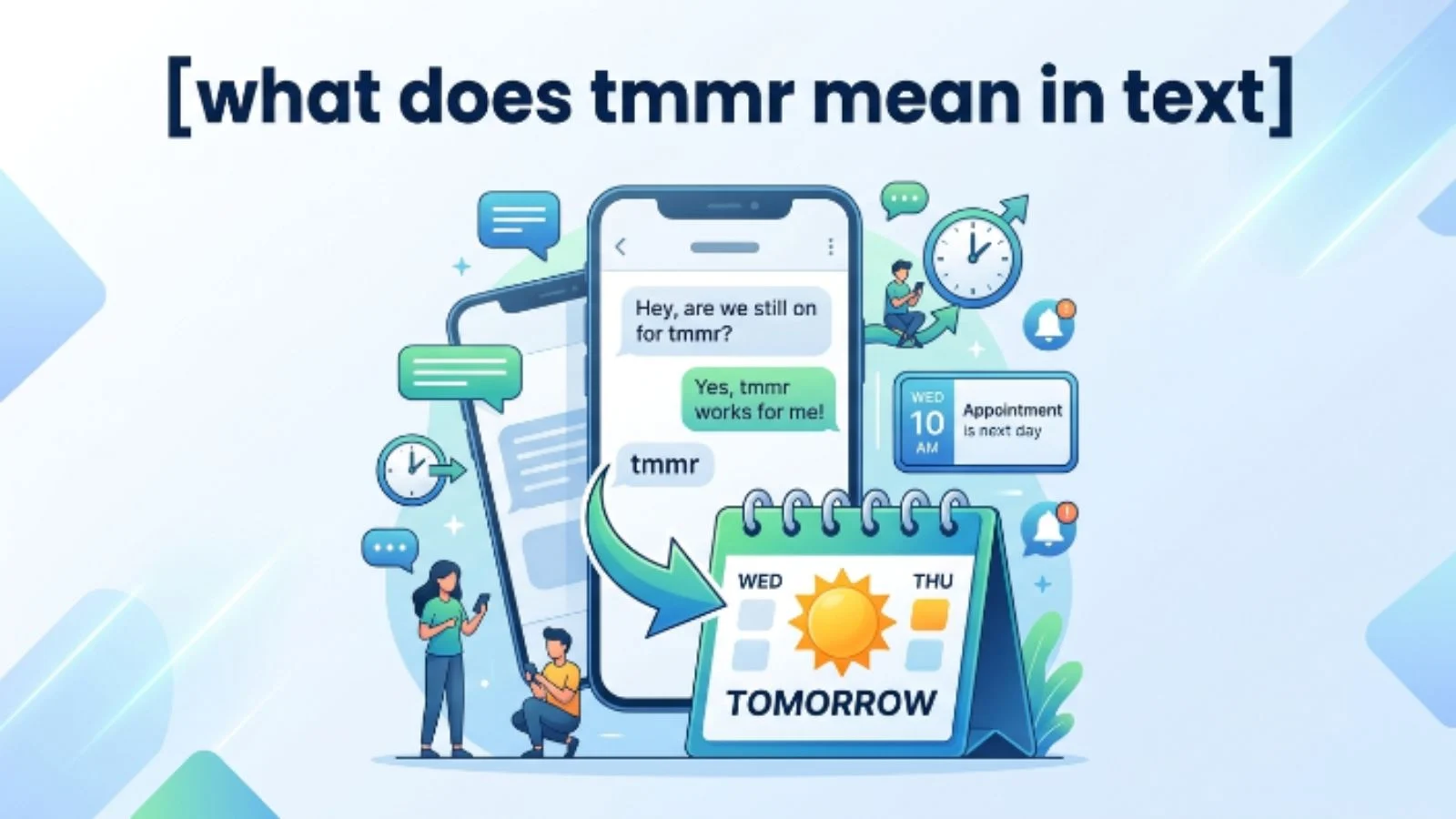
TMMR usually means “tomorrow.”
People use TMMR as a shortened version of the word tomorrow when texting, chatting, or posting online.
Quick definition:
TMMR means “tomorrow” in text messages and online conversations. It is an informal abbreviation used to save time and space.
For example:
- “I’ll see you tmmr.” = I’ll see you tomorrow.
- “Can we talk tmmr?” = Can we talk tomorrow?
- “I have an exam tmmr.” = I have an exam tomorrow.
The exact meaning is usually clear from the context of the conversation.
What Is the Simple Meaning of TMMR?
The simple meaning of TMMR is “tomorrow.”
It refers to the day after today. Instead of typing the complete word, someone may write TMMR to make their message shorter.
For example:
Full sentence:
“I will send you the details tomorrow.”
Texting version:
“I’ll send you the details tmmr.”
The meaning stays exactly the same. The only difference is that TMMR is more casual and informal.
Why Do People Use TMMR Instead of Tomorrow?
People use abbreviations like TMMR mainly because texting is fast and informal.
Here are some common reasons.
1. It Saves Time
Typing TMMR takes less time than typing tomorrow.
When someone is quickly replying to a message, short forms can make communication faster.
2. It Fits Casual Texting
Text messages, direct messages, and online chats often use shortened words.
People may write:
- u instead of you
- r instead of are
- tmrw instead of tomorrow
- tmmr instead of tomorrow
These forms are generally used in casual conversations.
3. It Is Easy to Understand
Although TMMR removes several letters from “tomorrow,” most people can understand it immediately from context.
For example:
“I’ll finish it tmmr.”
The meaning is obvious: the person will finish it tomorrow.
4. It Matches Modern Digital Communication
Online conversations often move quickly. People commonly shorten words to make messages feel more relaxed and natural.
However, the abbreviation is not usually suitable for formal writing.
Where Is TMMR Used?
You may see TMMR in many casual online spaces.
Common places include:
- Text messages
- WhatsApp chats
- Instagram direct messages
- Snapchat conversations
- Facebook Messenger
- TikTok messages
- Discord chats
- Online gaming chats
- Casual social media posts
The abbreviation can also appear in personal notes or informal group conversations.
Example:
Friend: Are you coming to the event?
You: Yes, I’ll confirm everything tmmr.
Here, tmmr simply means tomorrow.
Real-Life Examples of TMMR in Text
Understanding examples is one of the easiest ways to learn internet slang.
Example 1: Making Plans
Person A: Are you free today?
Person B: No, but I can meet you tmmr.
Meaning:
Person B is saying they can meet the next day.
Example 2: School or College
Student: I need to study tmmr.
Friend: Same. This exam is stressful.
Meaning:
The student plans to study tomorrow.
Example 3: Work
Coworker: When can you send the report?
You: I’ll send it tmmr morning.
Meaning:
The report will be sent the following day.
Example 4: Casual Conversation
Friend: What are you doing tmmr?
You: Probably staying home.
Meaning:
The person is asking about your plans for tomorrow.
Example 5: Making a Promise
“Don’t worry, I’ll explain everything tmmr.”
This means:
“Don’t worry, I’ll explain everything tomorrow.”
The tone is casual and friendly.
Example 6: Social Media
“New video coming tmmr.”
This means:
“A new video is coming tomorrow.”
You may see this type of usage in casual posts, stories, or captions.
TMMR vs Similar Abbreviations
TMMR is not the only short form people use for “tomorrow.” Several similar abbreviations exist.
| Abbreviation | Meaning | Common Use |
|---|---|---|
| TMMR | Tomorrow | Casual texting |
| TMRW | Tomorrow | Texting and social media |
| TMRO | Tomorrow | Informal messages |
| TOM | Tomorrow | Less common shorthand |
| 2MORO | Tomorrow | Casual texting |
| Tomorrow | Tomorrow | Formal and standard writing |
Although these abbreviations have the same general meaning, some are more common than others.
TMMR vs TMRW
Both TMMR and TMRW usually mean tomorrow.
Examples:
- “See you tmmr.”
- “See you tmrw.”
The meaning is the same. The choice often depends on personal preference.
TMMR vs TMRO
TMRO is another informal abbreviation for tomorrow.
For example:
“I’ll call you tmro.”
This means:
“I’ll call you tomorrow.”
TMMR vs 2MORO
2MORO is a more creative texting abbreviation. It uses the number 2 to represent the beginning sound of “to.”
Example:
“Talk to you 2moro.”
This also means:
“Talk to you tomorrow.”
When Should You Use TMMR?
You can use TMMR when the conversation is informal and relaxed.
It is suitable for:
- Talking with friends
- Messaging family members
- Chatting with classmates
- Casual group chats
- Social media conversations
- Informal online communities
For example:
“I’ll send you the photos tmmr.”
That sounds perfectly natural in a casual chat.
When Should You Avoid Using TMMR?
Although TMMR is understandable, you should avoid it in formal or professional writing.
Do not usually use TMMR in:
- Job applications
- Formal emails
- Business proposals
- Academic assignments
- Official documents
- Professional reports
Instead, write the complete word:
“I will send the report tomorrow.”
rather than:
“I’ll send the report tmmr.”
The complete word looks more professional and polished.
Common Misunderstandings About TMMR
Misunderstanding 1: TMMR Has a Different Hidden Meaning
In most texting situations, TMMR simply means “tomorrow.”
It is not usually a secret code or a phrase with a completely different meaning.
However, abbreviations can sometimes have different meanings in specialized communities. That is why context is always important.
Misunderstanding 2: TMMR Is a Formal English Word
It is not.
TMMR is informal texting shorthand, not standard formal English.
You may see it in digital conversations, but it is better to use tomorrow in professional or academic writing.
Misunderstanding 3: TMMR and TMRW Have Different Meanings
Usually, they do not.
Both commonly mean tomorrow.
The difference is mainly the spelling style used by the person texting.
Misunderstanding 4: The Capital Letters Change the Meaning
Usually, there is no major difference between:
- TMMR
- tmmr
- Tmmr
All generally mean tomorrow.
Capitalization often depends on the writer’s personal texting style.
How to Understand TMMR From Context
If you are unsure what TMMR means, look at the words around it.
For example:
“I’ll finish the project tmmr.”
The phrase “I’ll finish” suggests that the person is talking about a future time. Therefore, TMMR means tomorrow.
Another example:
“Are you free tmmr?”
Because the person is asking about your availability on a future day, the meaning is clearly tomorrow.
A Simple Context Rule
If TMMR appears in a sentence about:
- Plans
- Appointments
- Future events
- Deadlines
- Calls
- Meetings
- School
- Work
then it almost certainly means tomorrow.
TMMR in Different Types of Conversations
In Friendly Texting
“Hey, wanna hang out tmmr?”
Meaning:
“Do you want to hang out tomorrow?”
The tone is casual and friendly.
In Romantic Conversations
“Can I see you tmmr?”
Meaning:
“Can I see you tomorrow?”
The abbreviation does not automatically make the message romantic. The meaning depends on the overall conversation.
In Work Chats
“I’ll review the document tmmr.”
The meaning is still tomorrow, but using TMMR in a professional work chat may feel too informal depending on the workplace.
In Gaming Chats
“We can play tmmr.”
This means:
“We can play tomorrow.”
Short abbreviations are especially common in fast-paced online conversations.
Is TMMR Correct English?
TMMR is understandable but informal.
It is not the standard spelling of the word “tomorrow.” It is a shortened form created for casual digital communication.
Think of it as texting shorthand rather than traditional English vocabulary.
For formal writing, use:
tomorrow
For casual texting, you may see:
tmmr
Both communicate the same basic idea.
Pro Tips for Using TMMR Correctly
Tip 1: Use It With the Right Audience
TMMR works best when you are talking to people who understand texting abbreviations.
A close friend will probably understand it immediately.
However, if you are messaging a client, employer, teacher, or someone unfamiliar with slang, writing tomorrow is safer.
Tip 2: Consider the Tone
Abbreviations can make your message sound relaxed and casual.
Compare:
“I will contact you tomorrow.”
with:
“I’ll text you tmmr.”
The second version sounds more informal.
Tip 3: Avoid Overusing Abbreviations
A message filled with too many abbreviations can become difficult to read.
For example:
“I’ll msg u tmmr bc I’m busy rn.”
Many people understand this, but a clearer version is:
“I’ll message you tomorrow because I’m busy right now.”
Shortening a few words is fine. Making every word difficult to understand is not.
Tip 4: Use Context to Interpret It
If someone sends you TMMR, look at the full sentence before assuming its meaning.
In ordinary texting, it means tomorrow, but context is always the best guide.
Why Is TMMR Popular in Texting?
The popularity of abbreviations like TMMR comes from the way people communicate online.
Digital communication is often:
- Fast
- Short
- Informal
- Conversational
People frequently remove unnecessary letters to type faster. This is especially common when they are chatting on mobile phones.
Texting abbreviations also help messages feel more relaxed. A message such as “See you tmmr” can sound more casual than “I will see you tomorrow.”
Neither is wrong in the right context. They simply belong to different communication styles.
Frequently Asked Questions About TMMR
What does TMMR mean in text?
TMMR usually means “tomorrow.” It is an informal abbreviation commonly used in text messages, online chats, and social media conversations.
Is TMMR the same as TMRW?
Yes. In most casual conversations, TMMR and TMRW both mean “tomorrow.” They are simply different shortened spellings.
Can I use TMMR in a formal email?
It is better to avoid it. In formal emails, professional messages, academic writing, and official documents, write “tomorrow” instead.
Is TMMR rude or disrespectful?
No. TMMR is not inherently rude. It is simply casual texting shorthand. Whether it sounds appropriate depends on the situation and the person you are talking to.
Final Thoughts
So, what does TMMR mean in text? In most conversations, it simply means “tomorrow.”
You may see it in messages about plans, meetings, school, work, calls, or future events. For example, “I’ll see you tmmr” means “I’ll see you tomorrow.”
The abbreviation is useful in casual texting because it is short and easy to type. However, it is best to use the complete word “tomorrow” in formal, academic, or professional writing.
Once you understand the context, TMMR is one of the easiest texting abbreviations to recognize.