Have you ever received a text message with words inside brackets and wondered what they really meant? Maybe someone wrote, “(lol),” “[seriously],” or even “(I miss you)”, and you weren’t sure if it changed the meaning of the message.
The truth is that brackets in text messages don’t always have one fixed meaning. Depending on the type of brackets and the conversation, they can add emotion, provide extra information, show actions, express thoughts, or simply make a message easier to understand.
In this guide, you’ll learn exactly what brackets mean in text, when people use them, how they’re different from other punctuation, and how you can use them naturally in your own messages.
What Do Brackets Mean in Text?
Brackets in text are punctuation marks used to add extra information, show actions, clarify a message, express thoughts, or separate additional details from the main sentence. Their meaning depends on the context and the type of brackets being used.
In casual texting, brackets often make a message sound more natural or expressive. Instead of changing the meaning of a sentence, they usually add context or emotion.
For example:
- I’m almost there (5 minutes away).
- That movie was amazing (except the ending).
- (laughs) You’re so funny.
In each example, the words inside the brackets give you additional information without interrupting the main message.
Simple Meaning of Brackets in Text
In simple words, brackets are like whispering extra information.
Imagine talking to a friend.
You might say:
“I’ll come over later… by the way, I’m bringing pizza.”
In text, you could write:
“I’ll come over later (I’m bringing pizza).”
The information inside the brackets is helpful, but the main sentence still makes sense without it.
That’s why brackets are often called extra information markers.
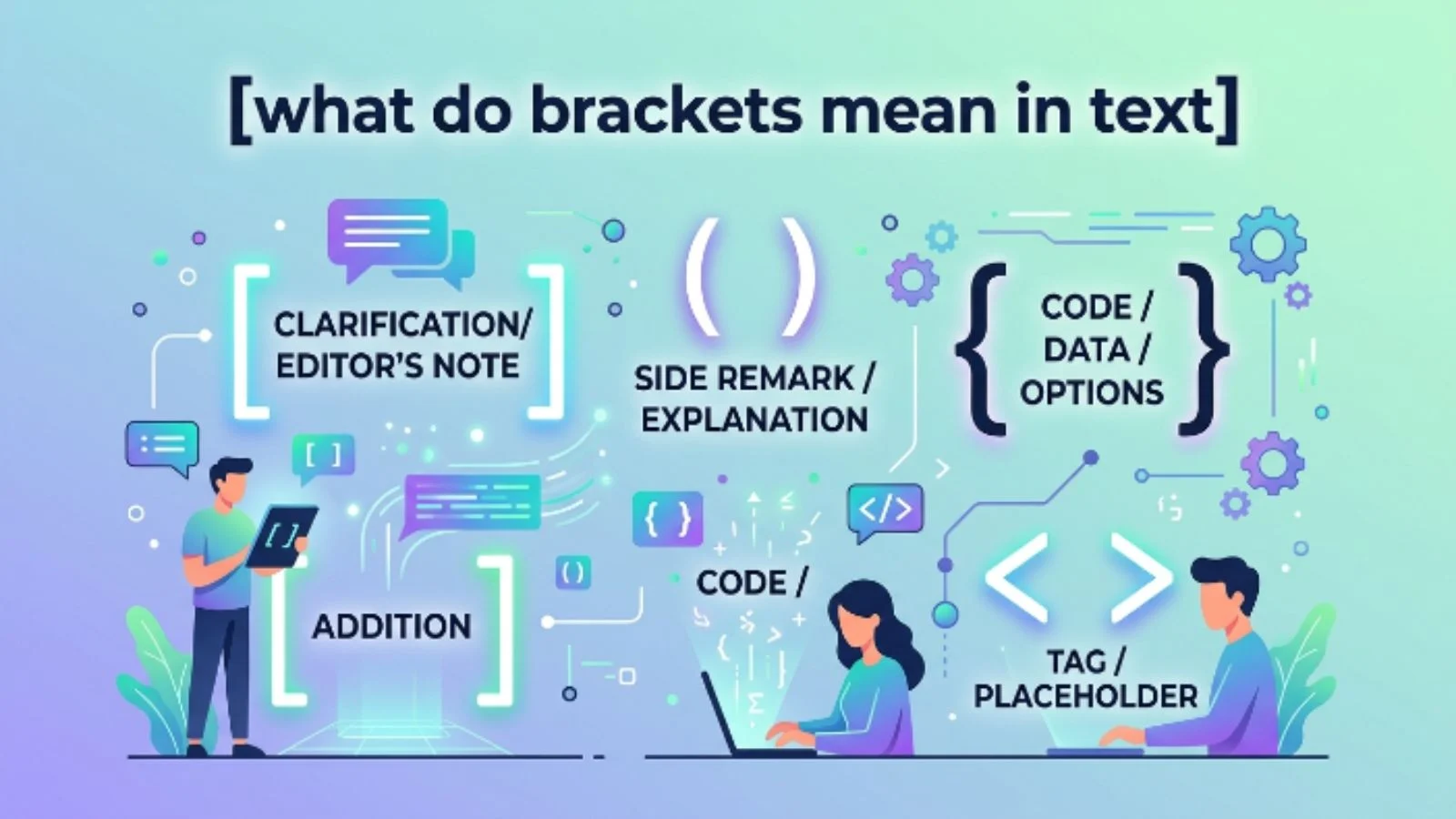
Different Types of Brackets Used in Text
Not every bracket is the same. Each one has a slightly different purpose.
Parentheses ( )
These are the most common brackets in texting.
People use them to:
- Add extra details
- Explain something
- Add humor
- Include side comments
- Show actions
Examples:
- I’ll call you tonight (after work).
- That was awkward (not going to lie).
- (laughs) You actually believed me.
Square Brackets [ ]
Square brackets are less common in everyday texting.
You’ll usually see them in:
- Edited quotes
- Online discussions
- Roleplay
- Gaming chats
- Storytelling
Example:
- [Everyone starts clapping.]
- [Message deleted.]
Curly Braces { }
These are rarely used in normal conversations.
They’re more common in:
- Programming
- Coding
- Technical discussions
- Mathematical expressions
Example:
- Select the option inside {Settings}.
Angle Brackets < >
These sometimes appear in online communities.
People may use them for:
- Tags
- Placeholder text
- Older internet chats
Example:
Where Are Brackets Used in Text?
You’ll find brackets almost everywhere people communicate online.
Text Messages
Friends often use brackets for side comments.
Example:
“I’ll be there soon (traffic is terrible).”
People explain situations without making messages too long.
Example:
“I’m busy right now (family dinner).”
Brackets often appear in captions.
Example:
“Best vacation ever (already planning another trip).”
Users add personal thoughts.
Example:
“We finally finished the project (after three months).”
Discord
Gamers and online communities frequently use brackets.
Example:
“[AFK for 10 minutes]”
People use brackets to clarify information.
Example:
“[Spoiler Alert]”
Online Games
Players often describe actions.
Example:
“[Heals teammate]”
Why Do People Use Brackets in Text?
There are many reasons people choose brackets instead of simply writing another sentence.
1. To Add Extra Information
The biggest reason is to include additional details.
Example:
“I’m leaving tomorrow (if the weather stays nice).”
2. To Explain Something
Sometimes people think the reader needs more context.
Example:
“I met Jake (my cousin from Texas).”
3. To Sound More Casual
Brackets make conversations feel relaxed.
Instead of saying:
“I’m tired. By the way, I worked all day.”
People write:
“I’m tired (worked all day).”
4. To Show Actions
This is very common in roleplay and gaming.
Examples:
- (laughs)
- (smiles)
- (waves)
- (hugs)
- (sighs)
5. To Add Humor
Many people use brackets for funny side comments.
Example:
“I totally meant to do that (I definitely didn’t).”
6. To Avoid Interrupting the Main Message
The main sentence stays easy to read while the bracket contains optional information.
Example:
“We’ll meet tomorrow (same coffee shop).”
Real-Life Examples of Brackets in Text
Example 1
Text:
“I finished the assignment (finally).”
Meaning:
The person feels relieved after completing it.
Example 2
Text:
“I’ll text you later (my phone is almost dead).”
Meaning:
They’re explaining why they may disappear.
Example 3
Text:
“(Laughs) That’s actually funny.”
Meaning:
They’re showing an action instead of describing it.
Example 4
Text:
“I wasn’t expecting that (at all).”
Meaning:
The brackets emphasize surprise.
Example 5
Text:
“Thanks for helping me (I really appreciate it).”
Meaning:
The bracket adds warmth and sincerity.
Example 6
Text:
“I’m okay (just tired).”
Meaning:
The sender reassures the reader while giving a little more information.
What Do Brackets Mean in Roleplay Text?
In roleplay chats, brackets often represent actions instead of spoken words.
Example:
- (Smiles)
- (Looks around)
- (Walks away)
- (Laughs loudly)
- (Gives you a gift)
This helps readers imagine what’s happening.
For example:
Alex: Good morning.
Jamie: (Smiles) Good morning.
The action creates a more vivid conversation.
What Do Brackets Mean on Social Media?
On social media, brackets usually provide additional context.
Examples:
- “Best concert ever (worth every penny).”
- “New haircut (still getting used to it).”
- “Long day (need coffee).”
People use them because they make captions feel personal and conversational.
What Do Brackets Mean in Online Communities?
Some online communities use brackets for labels.
Examples include:
- [Update]
- [Question]
- [Guide]
- [Solved]
- [Spoiler]
- [NSFW]
- [Discussion]
These tags help readers quickly understand what the post is about.
Brackets vs Parentheses vs Parentheses in Text
Many people use the words brackets and parentheses interchangeably.
Technically, there is a difference.
| Symbol | Name | Common Use |
|---|---|---|
| ( ) | Parentheses | Extra information, actions, explanations |
| [ ] | Square Brackets | Labels, edits, clarifications |
| { } | Curly Braces | Programming and technical writing |
| < > | Angle Brackets | Tags and technical uses |
In American English, people often call ( ) “parentheses.”
In British English, they’re sometimes simply called “brackets.”
When Should You Use Brackets in Text?
Brackets work best when you want to make your message clearer.
Good situations include:
- Adding helpful information
- Explaining a sentence
- Making jokes
- Showing actions
- Giving context
- Clarifying details
- Writing naturally
Example:
“I’ll call after dinner (around 8 PM).”
When Should You Avoid Using Brackets?
Although brackets are useful, they can make messages confusing if overused.
Avoid using them when:
- Every sentence contains brackets.
- The extra information is unnecessary.
- The message becomes difficult to read.
- The conversation is very formal.
For business emails or professional documents, complete sentences are usually a better choice.
Common Misunderstandings About Brackets
Myth 1: Brackets Always Mean Something Secret
Not true.
Most of the time, they’re simply adding extra information.
Myth 2: Brackets Are Only Used in Grammar
Wrong.
Millions of people use brackets every day in texting, gaming, and social media.
Myth 3: Brackets Change the Meaning of Every Sentence
Usually they don’t.
They simply provide more context.
Myth 4: Brackets Are Rude
No.
They’re generally considered neutral and friendly.
Tone depends on the words inside them, not the brackets themselves.
Pro Tips for Using Brackets Naturally
If you want your messages to sound smooth and easy to read, keep these tips in mind.
- Use brackets only when the extra information is helpful.
- Don’t place every thought inside brackets.
- Keep bracketed text short.
- Use them to clarify, not confuse.
- Avoid multiple nested brackets.
- Read your message before sending it to ensure it still flows naturally.
Simple, clear writing is always more effective than overcomplicating your message.
Final Thoughts
So, what do brackets mean in text? In most conversations, they simply provide extra information, explanations, emotions, actions, or side comments without changing the main message. Whether you’re texting a friend, posting on social media, chatting in a game, or writing online, brackets help make your communication more natural and expressive.
The key is to use them thoughtfully. A well-placed bracket can add clarity or personality, but using too many can make your message harder to read. When used correctly, brackets are a simple yet effective way to communicate exactly what you mean.
Frequently Asked Questions
What do brackets mean in text messages?
Brackets usually contain additional information, explanations, actions, or side comments that support the main message without changing its core meaning.
Are brackets and parentheses the same?
Not exactly. Technically, ( ) are called parentheses, while [ ] are square brackets. However, many people casually refer to both as brackets.
Why do people put actions in brackets?
People use brackets to describe actions such as (laughs) or (smiles) instead of writing them as spoken words. This is especially common in roleplay, gaming, and informal chats.
Should I use brackets in professional messages?
You can use brackets sparingly to add brief clarifications, but in formal or business communication, complete sentences are usually clearer and more professional.