Have you ever received a text that simply said “ASL?” and wondered what the person was actually asking?
You are not alone. ASL is one of those texting abbreviations that can mean different things depending on the conversation. In most online chats, it traditionally means “Age, Sex, Location.” However, in modern texting and social media, many people also use ASL to mean “as hell.”
So, what does ASL mean in text? The answer depends entirely on the context.
In this guide, you will learn the most common meanings of ASL, how people use it in conversations, real-life examples, similar abbreviations, common misunderstandings, and how to understand its meaning correctly.
What Does ASL Mean in Text?
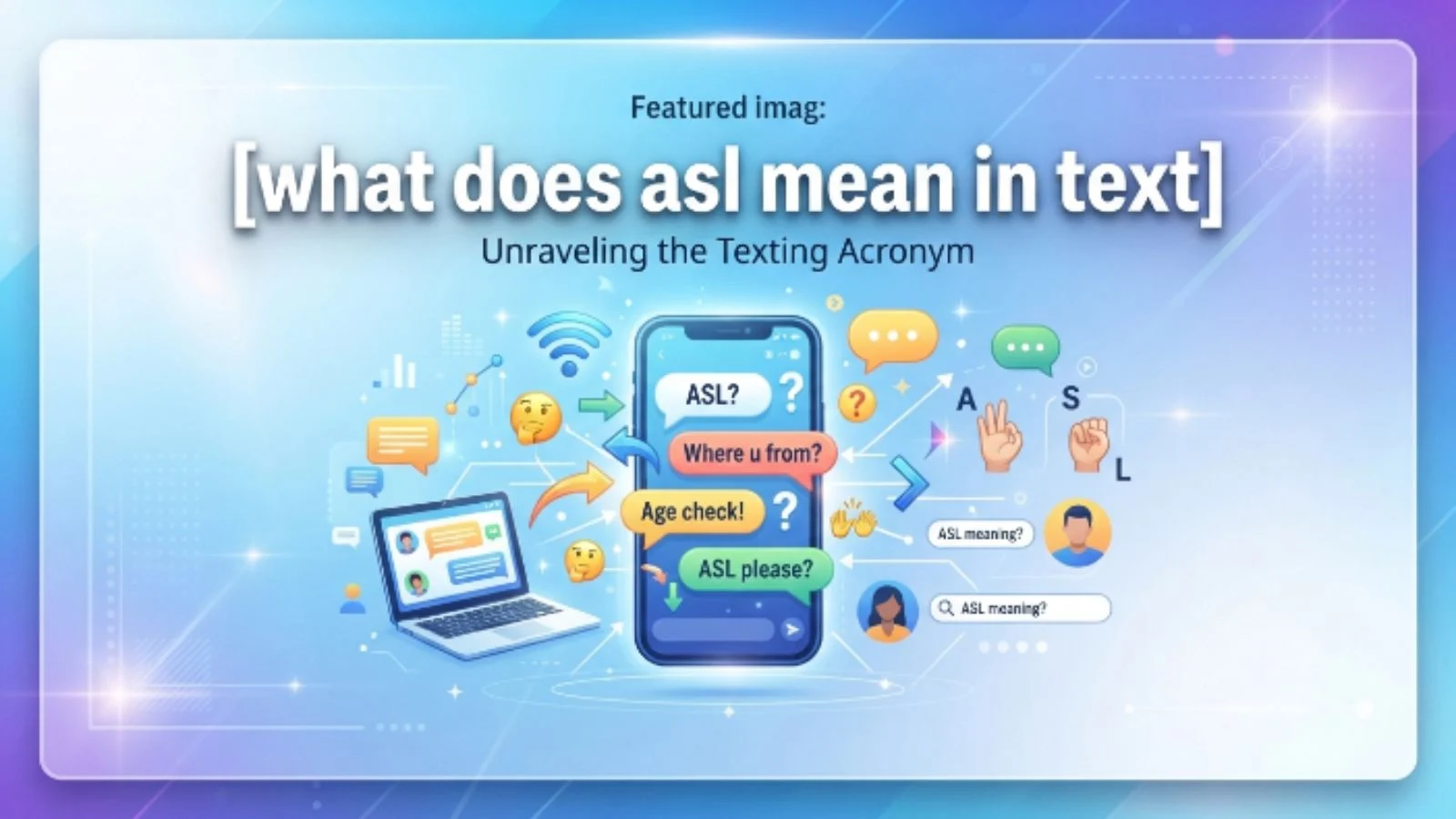
In texting and online conversations, ASL most commonly means “Age, Sex, Location.”
People traditionally used it as a quick way to ask someone:
- A = Age
- S = Sex
- L = Location
For example:
“Hey, ASL?”
This usually means:
“How old are you, what is your sex or gender, and where are you located?”
However, ASL can also mean “as hell” in casual internet slang.
For example:
“That movie was funny ASL.”
Here, ASL means:
“That movie was funny as hell.”
The correct meaning depends on the sentence, the platform, and the conversation.
ASL Meaning in Simple Words
The easiest way to understand ASL in text is to look at the context.
Meaning 1: Age, Sex, Location
This is the traditional internet slang meaning.
Someone might write:
“ASL?”
They are asking for basic personal information.
A possible reply could be:
“21, female, Texas.”
However, many people today avoid answering this question directly because sharing personal information with strangers online can create privacy and safety concerns.
Meaning 2: As Hell
In modern texting and social media conversations, ASL can also be used as a shortened form of “as hell.”
For example:
“I’m tired ASL today.”
This means:
“I’m extremely tired today.”
Another example:
“That game was hard ASL.”
This means:
“That game was extremely hard.”
In this usage, ASL acts as an intensifier. It emphasizes the word before it.
Why Does ASL Have Multiple Meanings?
Internet slang changes constantly.
Many abbreviations that were popular in chat rooms years ago now have new meanings on platforms such as TikTok, Instagram, Snapchat, Discord, and text messaging apps.
The original meaning of ASL became popular during the early days of online chat rooms and instant messaging. People wanted a fast way to ask for someone’s age, sex, and location.
Over time, younger internet users began using ASL as an abbreviation for “as hell.”
That is why the same three letters can have completely different meanings.
For example:
“ASL?”
Probably means:
“Age, Sex, Location?”
But:
“I’m hungry ASL.”
Probably means:
“I’m extremely hungry.”
The words surrounding the abbreviation usually reveal the intended meaning.
Where Is ASL Used in Texting?
You may see ASL in several online environments.
Text Messages
Friends may use ASL casually in private conversations.
Example:
“You look tired ASL.”
Meaning:
“You look extremely tired.”
Social Media
On platforms such as TikTok, Instagram, Facebook, and X, ASL may appear in comments or captions.
Example:
“This video is funny ASL.”
The meaning here is “funny as hell.”
Online Chat Rooms
The older meaning, “Age, Sex, Location,” is especially associated with online chat rooms and conversations with strangers.
Example:
“Hi, ASL?”
The person is asking for basic information about you.
Gaming Communities
Gamers sometimes use ASL to intensify a description.
Example:
“That boss fight was difficult ASL.”
Meaning:
“That boss fight was extremely difficult.”
Dating and Social Apps
The meaning “Age, Sex, Location” may still appear when someone wants to learn basic information about another person.
However, you should be cautious about sharing personal details with strangers online.
Why Do People Use ASL?
People use ASL because texting abbreviations make conversations faster.
Instead of typing:
“That was funny as hell.”
Someone may write:
“That was funny ASL.”
Similarly, instead of typing:
“What is your age, sex, and location?”
Someone might simply write:
“ASL?”
Short abbreviations are especially common in fast-moving online conversations.
People may use them because they:
- Save time while typing
- Make messages feel more casual
- Match internet culture
- Add emphasis to a sentence
- Make conversations feel informal
- Help people communicate quickly
However, abbreviations can sometimes create confusion, especially when they have multiple meanings.
Real-Life Examples of ASL in Text
Here are some practical examples to help you understand the meaning of ASL.
Example 1: “ASL?”
Person A: Hey, who are you?
Person B: Just someone from the chat.
Person A: ASL?
Here, ASL means “Age, Sex, Location.”
The person wants to know basic information about the other person.
Example 2: “I’m tired ASL.”
Person A: Are you coming out tonight?
Person B: No, I’m tired ASL.
Here, ASL means “as hell.”
The person is saying:
“I’m extremely tired.”
Example 3: “That was funny ASL.”
Person A: Did you watch the video?
Person B: Yes, that was funny ASL.
Here, ASL means:
“Funny as hell.”
The speaker is strongly emphasizing how funny the video was.
Example 4: “This exam was hard ASL.”
This means:
“This exam was extremely hard.”
The abbreviation adds strong emphasis to the word hard.
Example 5: “Who are you? ASL?”
This is an example of the traditional meaning.
The person may be asking:
- How old are you?
- What is your sex or gender?
- Where are you located?
The exact interpretation can depend on the platform and the people involved.
How Can You Tell Which Meaning of ASL Someone Intended?
The best way to understand ASL is to examine the sentence.
If ASL Appears Alone
Example:
“ASL?”
It probably means:
“Age, Sex, Location?”
This is especially likely if you are chatting with someone you do not know.
If ASL Appears After an Adjective
Example:
“That food was good ASL.”
It probably means:
“That food was good as hell.”
Words such as these often appear before ASL:
- Funny
- Tired
- Hungry
- Cold
- Hot
- Difficult
- Good
- Crazy
- Expensive
- Beautiful
If Someone Is Asking Personal Questions
Example:
“How old are you? ASL?”
The meaning is probably related to age, sex, and location.
If the Sentence Describes an Emotion or Experience
Example:
“I’m bored ASL.”
The meaning is probably:
“I’m extremely bored.”
Context is the key.
ASL vs. Similar Texting Terms
ASL can sometimes be confused with other internet abbreviations.
| Abbreviation | Meaning | Example |
|---|---|---|
| ASL | Age, Sex, Location / As Hell | “ASL?” or “Tired ASL” |
| AF | As F*** | “That was funny AF” |
| OMG | Oh My God | “OMG, that was crazy!” |
| WYD | What You Doing? | “WYD tonight?” |
| HBU | How About You? | “I’m good, HBU?” |
| IDK | I Don’t Know | “IDK what happened.” |
| FR | For Real | “That was amazing, FR.” |
The main difference is that ASL has two very different common meanings, while many other abbreviations have one primary interpretation.
ASL vs. AF: Are They the Same?
Sometimes, ASL and AF can have a similar meaning.
For example:
“That movie was scary ASL.”
and:
“That movie was scary AF.”
Both mean:
“That movie was extremely scary.”
However, AF contains profanity, while ASL may be seen as a less direct alternative in some conversations.
Still, ASL is not always interchangeable with AF because ASL can also mean “Age, Sex, Location.”
The surrounding words determine the meaning.
When Should You Use ASL?
You can use ASL in casual online conversations when the people involved understand internet slang.
It may be appropriate when:
- You are texting friends
- You are chatting casually online
- You are commenting on social media
- You are talking in a gaming community
- You are using informal language
For example:
“That concert was amazing ASL.”
This is a casual and informal message.
However, you should avoid using ASL in formal situations.
It is generally not suitable for:
- Professional emails
- Job applications
- Academic assignments
- Formal business communication
- Official documents
Instead of writing:
“The project was difficult ASL.”
In a professional setting, write:
“The project was extremely challenging.”
The full phrase is clearer and more appropriate.
Is ASL Rude?
Usually, ASL is not automatically rude.
The meaning and tone depend on how it is used.
“ASL?” Can Feel Personal
If a stranger suddenly asks:
“ASL?”
they are requesting personal information.
Some people may find this uncomfortable, especially because age, gender, and location can be sensitive details.
You do not have to answer.
You can simply say:
“I’d rather not share personal information.”
Or:
“I prefer to keep that private.”
“As Hell” Can Be Informal
When ASL means “as hell,” it is usually casual and sometimes slightly vulgar.
For example:
“That was expensive ASL.”
This may be perfectly normal among friends, but it is not ideal for formal communication.
Common Misunderstandings About ASL
Misunderstanding 1: ASL Always Means Age, Sex, Location
This was the traditional meaning, but it is not the only meaning today.
If someone says:
“I’m hungry ASL.”
They are not asking for your age, sex, or location.
They mean:
“I’m extremely hungry.”
Misunderstanding 2: ASL Always Means As Hell
This is also incorrect.
If someone simply writes:
“ASL?”
they may be asking for your age, sex, and location.
The sentence structure matters.
Misunderstanding 3: ASL Means American Sign Language in Every Conversation
ASL can also stand for American Sign Language, a visual language used by many Deaf and hard-of-hearing people.
For example:
“I’m learning ASL.”
In this sentence, ASL almost certainly means American Sign Language, not internet slang.
This is an important distinction.
The meaning depends heavily on the topic.
ASL Can Also Mean American Sign Language
Although this article focuses on texting slang, ASL has another major meaning: American Sign Language.
For example:
“Do you know ASL?”
This could mean:
“Do you know American Sign Language?”
If the conversation is about communication, Deaf culture, accessibility, or language learning, ASL probably refers to American Sign Language.
Compare these examples:
“I’m tired ASL.”
Meaning: “I’m tired as hell.”
“I’m studying ASL.”
Meaning: “I’m studying American Sign Language.”
The surrounding words make the intended meaning clear.
Pro Tips for Understanding ASL Correctly
1. Look at the Position of ASL
If ASL appears at the end of a sentence after a descriptive word, it often means “as hell.”
Example:
“That was crazy ASL.”
If ASL appears alone as a question, it may mean “Age, Sex, Location?”
2. Consider the Conversation Topic
If the conversation is about sign language, ASL probably means American Sign Language.
If the conversation is about a person’s identity, it may mean Age, Sex, Location.
If the conversation is casual and emotional, it may mean As Hell.
3. Do Not Assume the Meaning Immediately
When an abbreviation has multiple meanings, context is more important than the letters themselves.
If you are unsure, you can ask:
“What do you mean by ASL?”
This is completely reasonable.
4. Be Careful With Personal Information
If someone online asks:
“ASL?”
you are not required to share your age, gender, or location.
Only share personal information when you feel comfortable and trust the person.
5. Remember That Slang Changes
Internet language is constantly evolving.
A meaning that was popular years ago may become less common, while a newer meaning may become more popular on social media.
That is why context should always come first.
How to Reply When Someone Texts “ASL?”
Your reply depends on what you think the person means.
If They Mean Age, Sex, Location
You can answer only what you feel comfortable sharing.
For example:
“I’m in my twenties, and I’m from Pakistan. I prefer not to share more personal details.”
You can also simply say:
“Why do you ask?”
If You Are Unsure
You can write:
“Do you mean age, sex, location?”
This avoids confusion.
If ASL Means “As Hell”
You usually do not need to respond specifically to the abbreviation.
Example:
Friend: I’m hungry ASL.
You: Same. Let’s get something to eat.
The abbreviation simply adds emphasis to the statement.
Frequently Asked Questions About ASL
What does ASL mean in text messages?
In text messages, ASL can mean “Age, Sex, Location” or “as hell.” The meaning depends on the context. It can also refer to American Sign Language when the conversation is about language or Deaf culture.
What does “ASL?” mean in a chat?
When someone sends only “ASL?”, it traditionally means “Age, Sex, Location?” They may be asking your age, gender, and where you are located.
However, the exact meaning can depend on the platform and conversation.
What does “funny ASL” mean?
“Funny ASL” usually means “funny as hell.” In this usage, ASL emphasizes the word funny and means extremely funny.
Is ASL slang appropriate for professional conversations?
Generally, no. When ASL means “as hell,” it is informal internet slang. When it means “Age, Sex, Location,” it is also casual. In professional communication, using the full phrase is usually clearer and more appropriate.
Final Thoughts
So, what does ASL mean in text? The answer depends on the context.
The traditional meaning is “Age, Sex, Location,” especially when someone writes “ASL?” by itself. In modern internet slang, ASL can also mean “as hell,” as in “tired ASL” or “funny ASL.” In conversations about language and Deaf culture, it can mean American Sign Language.
The best way to understand ASL is to look at the words around it and consider the topic of the conversation. If you are unsure, simply ask what the person means.
Understanding texting abbreviations is not just about memorizing definitions. It is about recognizing how people use language in real conversations. Once you understand the context, ASL becomes much easier to interpret.