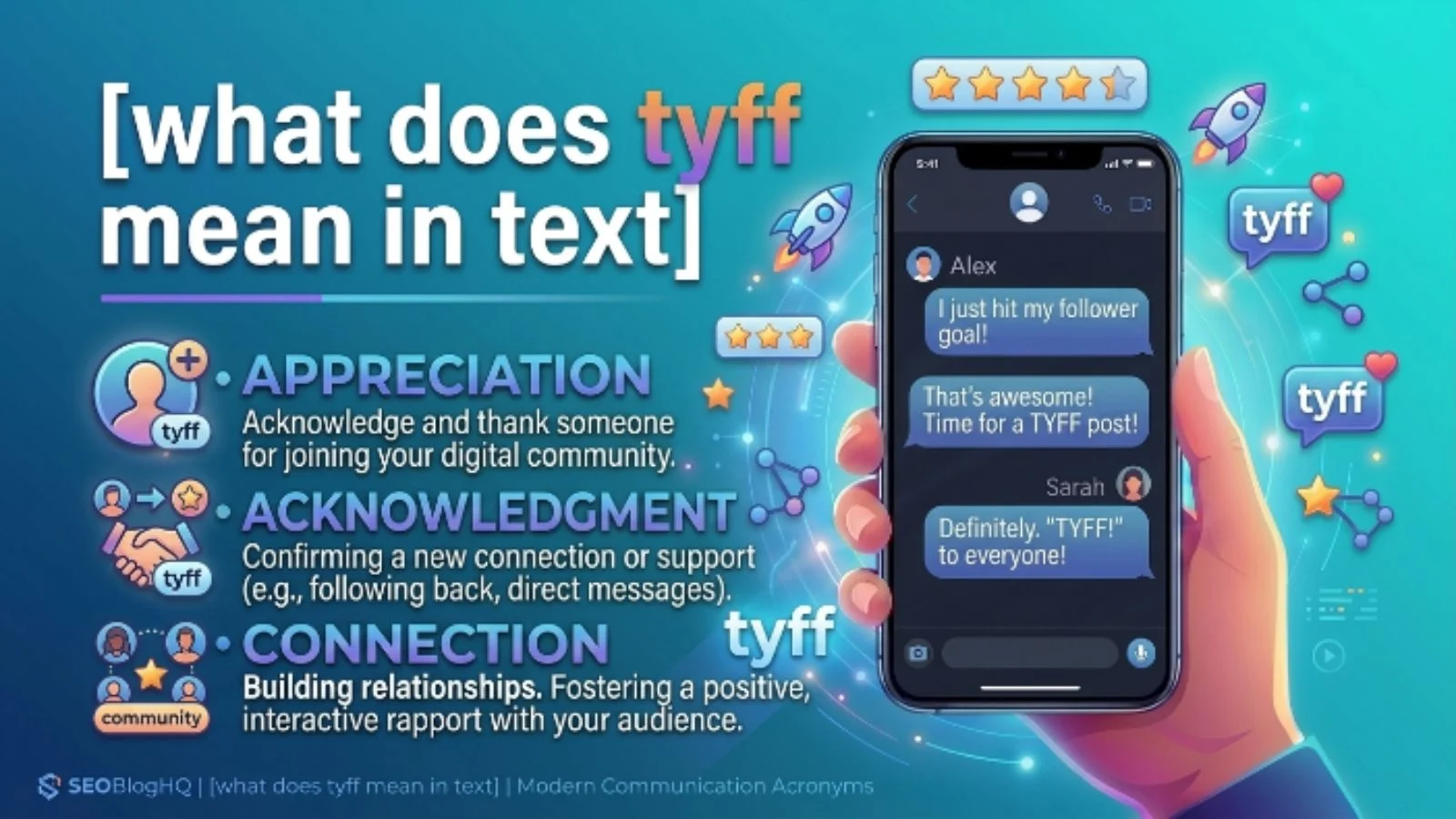
If you’ve received a message saying “TYFF” and had no idea what it meant, you’re not alone. Internet slang changes quickly, and new abbreviations appear every year across texting apps, social media, gaming chats, and online communities.
The short answer is:
TYFF means “Thank You For Following.”
People commonly use it after someone follows them on social media platforms. It’s a quick and friendly way to thank a new follower without typing a full sentence.
Although TYFF isn’t as common as abbreviations like LOL, BRB, or TYSM, it still appears on platforms where users gain followers and interact with new audiences.
In this complete guide, you’ll learn:
- The meaning of TYFF
- Where it came from
- When to use it
- Real-life examples
- Sample conversations
- Common mistakes
- Alternative meanings
- FAQs
- Modern usage in 2026
What Does TYFF Mean?
TYFF stands for:
Thank You For Following
It is a short way of expressing appreciation when someone follows your account.
Instead of writing:
Thank you for following me!
People simply type:
TYFF!
The abbreviation saves time while still sounding friendly and polite.
Simple Definition
TYFF = Thank You For Following
It is mainly used:
- On social media
- In direct messages
- In comment replies
- On streaming platforms
- Inside creator communities
Quick Meaning Table
| Term | Meaning | Used For |
|---|---|---|
| TYFF | Thank You For Following | Thanking new followers |
| TYSM | Thank You So Much | Showing gratitude |
| TY | Thank You | General thanks |
| THX | Thanks | Casual appreciation |
| TIA | Thanks In Advance | Asking for help politely |
How Do You Pronounce TYFF?
Most people don’t pronounce it as a word.
Instead, they read each letter separately:
T-Y-F-F
Some simply read it silently while texting.
What Does TYFF Mean in Simple English?
Imagine this situation.
You follow someone’s account.
A few seconds later they message:
TYFF!
They simply mean:
“Thank you for following me.”
Nothing complicated.
It is just a shorter version.
Where Is TYFF Used?
You may see TYFF on many online platforms.
These include:
- TikTok
- X (formerly Twitter)
- Twitch
- Kick
- YouTube
- Discord
- Threads
- Bluesky
- Gaming communities
Creators often send TYFF messages automatically or personally after getting new followers.
Origin and History of TYFF
Unlike famous abbreviations such as LOL or OMG, TYFF does not have a well-documented history.
It likely developed naturally as social media became more popular.
Around the early growth of creator platforms, people wanted faster ways to thank new followers.
Instead of typing:
Thank you for following.
They shortened it into:
TYFF
Although it never became one of the most popular internet abbreviations, it continues to appear among creators and small online communities.
In 2026, TYFF is still recognised, but many users now prefer writing the complete sentence because it feels warmer and more personal.
Why Do People Use TYFF?
People like short messages.
TYFF helps them:
- Save time
- Respond quickly
- Welcome followers
- Build friendly relationships
- Show appreciation
Even a small thank-you can encourage people to stay engaged with your content.
Is TYFF Polite?
Yes.
It is considered a polite abbreviation.
It shows appreciation without sounding formal.
For example:
TYFF!
is friendly.
Whereas:
Thank you very much for following my profile.
sounds much more formal.
Real-Life Examples of TYFF
Let’s look at simple examples.
Example 1
Message
TYFF!
Meaning
The sender is thanking you for following their account.
Example 2
Message
TYFF! Hope you enjoy my posts.
Meaning
They appreciate your follow and hope you’ll continue supporting their content.
Example 3
Message
TYFF. Welcome to the community.
Meaning
They are greeting a new follower.
Example 4
Message
TYFF! New videos every week.
Meaning
The creator thanks you while introducing their content schedule.
Example 5
Message
TYFF! Feel free to ask questions anytime.
Meaning
The person is inviting interaction after thanking you.
Short Dialogues Using TYFF
Conversation 1
Ali:
I just followed your photography page.
Sara:
TYFF!
Explanation
Sara is thanking Ali for becoming a follower.
Conversation 2
John:
Your gaming videos are awesome.
Creator:
TYFF! Glad you’re here.
Explanation
The creator appreciates both the compliment and the follow.
Conversation 3
Emma:
Following!
Lucas:
TYFF! Have a great day.
Explanation
Lucas responds politely after gaining a new follower.
Conversation 4
Follower:
Your travel tips helped me a lot.
Creator:
TYFF! More guides are coming soon.
Explanation
The creator thanks the follower and shares future plans.
When Should You Use TYFF?
TYFF is appropriate when someone:
- Follows your account
- Joins your page
- Supports your content
- Becomes a subscriber (in some communities)
- Starts following your updates
When Should You Avoid TYFF?
Do not use TYFF:
- During business emails
- Academic writing
- Job applications
- Professional reports
- Formal customer support
- Legal documents
In formal communication, write:
Thank you for following.
instead.
Personality Traits Associated with TYFF Users
People who use TYFF often appear:
- Friendly
- Appreciative
- Social
- Welcoming
- Supportive
- Active online
- Community-focused
Of course, using TYFF does not define someone’s personality, but it often reflects a positive attitude toward their audience.
Modern Usage in 2026
Internet language keeps changing.
In 2026:
Many creators now choose full messages because they feel more genuine.
Instead of:
TYFF
they may write:
Thanks for following!
or
Thank you for joining!
However, TYFF is still used in:
- Creator communities
- Gaming groups
- Small businesses
- Fan pages
- Niche online communities
Similar Texting Abbreviations
| Abbreviation | Meaning |
|---|---|
| TY | Thank You |
| TYSM | Thank You So Much |
| THX | Thanks |
| TYSM | Thank You So Much |
| TIA | Thanks In Advance |
| NP | No Problem |
| YW | You’re Welcome |
| WLCM | Welcome |
TYFF vs TYSM
| TYFF | TYSM |
|---|---|
| Thank You For Following | Thank You So Much |
| Used after someone follows | Used for any kind of thanks |
| Mostly social media | Used everywhere |
| Audience-specific | General appreciation |
Why Some People Have Never Seen TYFF
Many abbreviations become popular only inside certain groups.
TYFF is one of them.
You may never encounter it if you mainly use:
- SMS
- Workplace chats
- School messaging
Instead, you’ll mostly find it among:
- Influencers
- Content creators
- Twitch streamers
- Artists
- Community managers
Benefits of Using TYFF
Using TYFF can:
- Save typing time
- Welcome followers quickly
- Encourage engagement
- Build stronger online communities
- Make conversations friendly
Possible Drawbacks
Not everyone knows the abbreviation.
Some people may ask:
“What does TYFF mean?”
Others might mistake it for another internet term.
If your audience is unfamiliar with internet slang, writing the complete phrase may be a better choice.
Common Mistakes About TYFF
Mistake 1: Thinking It Means “Thank You Forever”
Incorrect.
It means:
Thank You For Following.
Mistake 2: Using It in Emails
Avoid writing:
TYFF for your application.
Instead write:
Thank you.
Mistake 3: Assuming Everyone Knows It
TYFF is not as common as LOL or OMG.
Some readers may not understand it immediately.
Mistake 4: Using It Outside Social Media
TYFF mainly fits follower-based platforms.
It may sound confusing in unrelated conversations.
Alternative Ways to Say Thank You for Following
Instead of TYFF, you can write:
- Thanks for following!
- Thank you for following me.
- Glad to have you here.
- Welcome aboard.
- Happy you’re here.
- Thanks for joining my page.
- Appreciate the follow.
- Thanks for your support.
These alternatives often feel warmer and more personal.
Is TYFF Still Popular in 2026?
TYFF remains a recognised abbreviation, but it is considered less common than broader expressions like “Thanks for following!” or “TYSM.”
Many creators now prefer full, conversational replies because they help build stronger connections with followers. Still, TYFF continues to appear in niche communities, automated welcome messages, and quick social media interactions.
Tips for Using TYFF Naturally
- Use it only after someone follows your account.
- Pair it with a friendly message for a personal touch.
- Avoid using it in formal communication.
- Remember that some people may not recognise the abbreviation.
- Consider writing the full phrase if your audience is broad or new to internet slang.
Frequently Asked Questions
What does TYFF stand for?
TYFF stands for Thank You For Following. It is a short way to thank someone who has followed your social media account.
Is TYFF commonly used?
It is recognised but not extremely common. Many people now prefer writing “Thanks for following!” instead, although TYFF is still used in some online communities.
Can I use TYFF on Instagram?
Yes. TYFF is commonly used on Instagram in direct messages, comments, or welcome messages to thank new followers.
Is TYFF formal?
No. TYFF is an informal internet abbreviation and should be used only in casual online conversations.
Is TYFF the same as TYSM?
No. TYFF means Thank You For Following, while TYSM means Thank You So Much. They are used in different situations.
Should businesses use TYFF?
Businesses can use TYFF on social media if their brand voice is casual and friendly. For more professional communication, writing the full phrase “Thank you for following” is usually clearer.
Conclusion
Understanding what TYFF means in text is simple once you know the context. TYFF stands for “Thank You For Following,” and it is mainly used on social media to welcome and appreciate new followers. While it is not one of the most widely used internet abbreviations in 2026, it remains useful in creator communities, gaming platforms, and casual online conversations. If your audience may not recognise the abbreviation, writing “Thanks for following!” can make your message clearer and more personal. As internet language continues to evolve, choosing the right expression for your audience helps build stronger connections and more meaningful online interactions.