Have you ever received a text like “I’ll opt for the first one” or “You can opt in later” and wondered what OPT actually means?
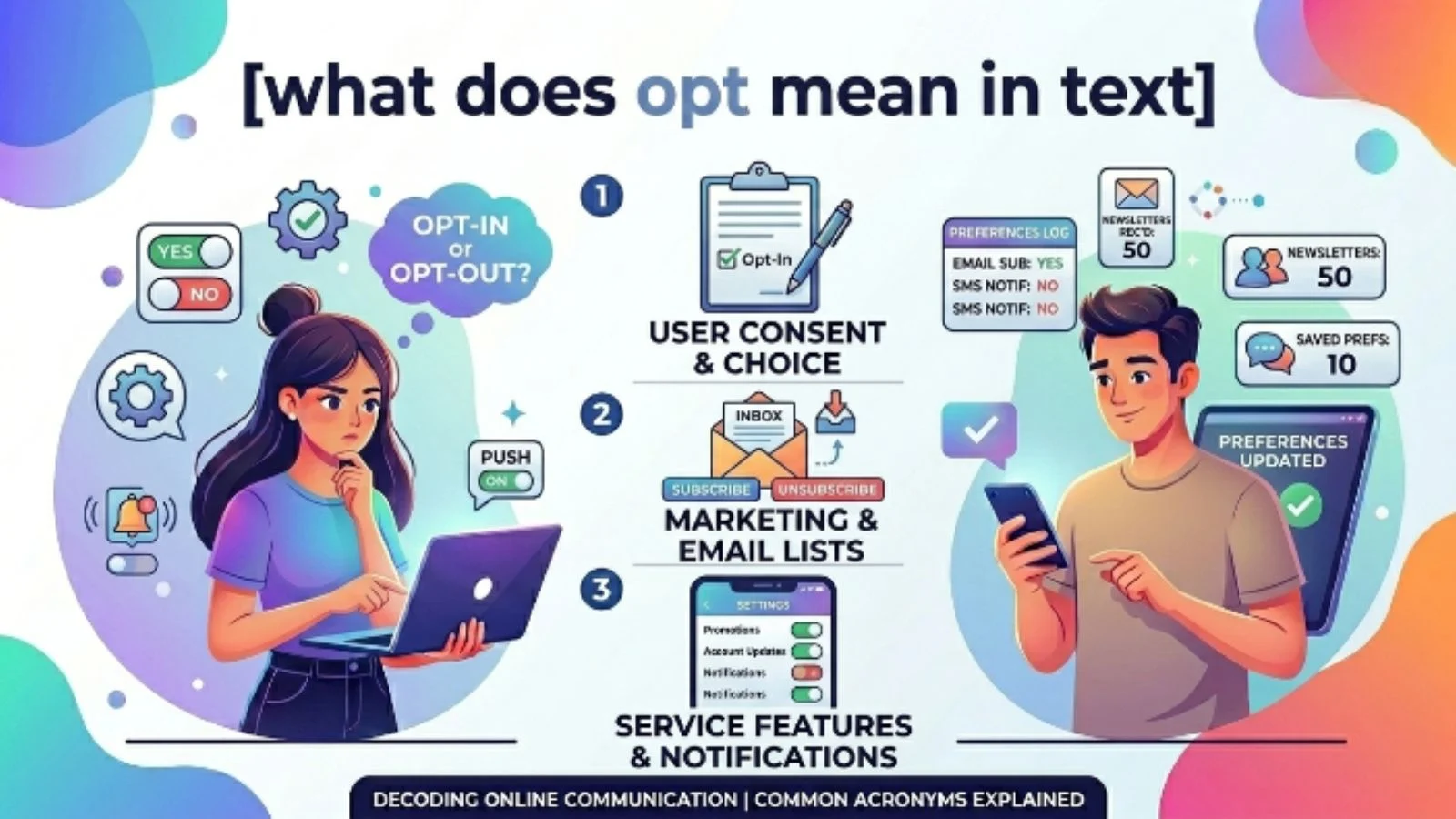
You are not alone. “Opt” is a short word that can look like texting slang, but its meaning is usually much simpler than it seems. In most conversations, opt means to choose, select, or decide on something.
However, the exact meaning can change slightly depending on the sentence. It can also appear in phrases such as “opt in,” “opt out,” and “opt for.”
In this guide, you’ll learn exactly what does opt mean in text, how people use it in messages, what similar terms mean, and how to understand it from context.
What Does OPT Mean in Text?
OPT usually means “choose,” “select,” or “decide to take a particular option.”
For example:
“I’ll opt for pizza.”
This means:
“I’ll choose pizza.”
Unlike many texting abbreviations, opt is not normally an acronym. It is simply a shortened-looking form of the verb “opt,” which is a standard English word.
The word is commonly used in texting, social media, emails, online conversations, and everyday speech.
Simple Definition
OPT = to choose or decide on something.
For example:
- “I opted for the blue one.” = I chose the blue one.
- “You can opt out.” = You can choose not to participate.
- “She opted in.” = She chose to participate.
- “We opted for delivery.” = We chose delivery.
So, when someone uses opt in a text, look at the words around it to understand exactly what they mean.
What Does “Opt” Mean in Simple Words?
In very simple English, opt means “choose.”
Imagine your friend asks:
“Do you want coffee or tea?”
You answer:
“I’ll opt for coffee.”
You are simply saying:
“I choose coffee.”
The word “opt” can sound slightly more formal than “choose,” but people use it naturally in online conversations.
It does not usually indicate a hidden message, secret slang, or offensive meaning.
What Does OPT Mean in a Text Message?
In a normal text message, opt generally means to make a choice.
The meaning depends on the phrase being used.
1. “Opt for” Means Choose
This is one of the most common uses.
“I’ll opt for the cheaper plan.”
Meaning:
“I’ll choose the cheaper plan.”
Another example:
“She opted for a movie instead.”
This means she chose a movie instead of another option.
2. “Opt in” Means Choose to Participate
Opt in means choosing to join, receive, or participate in something.
For example:
“You can opt in to receive notifications.”
This means:
“You can choose to receive notifications.”
You may see “opt in” when discussing subscriptions, newsletters, apps, services, surveys, or online programs.
3. “Opt out” Means Choose Not to Participate
Opt out is the opposite of opt in.
For example:
“I decided to opt out of the group activity.”
This means:
“I decided not to participate.”
Another example:
“You can opt out of promotional emails.”
That means you can choose not to receive those emails.
Where Is “OPT” Used?
The word opt can appear almost anywhere people communicate.
You may encounter it in:
- Text messages
- WhatsApp conversations
- Facebook messages
- Instagram DMs
- Snapchat chats
- TikTok comments
- Emails
- Online forms
- Websites
- Gaming communities
- Workplace communication
- School conversations
- Customer-service messages
It is especially common when someone is talking about different choices or options.
For example:
“You can opt for the monthly plan.”
This could appear in a conversation about a subscription.
Similarly:
“I’m going to opt out this time.”
This could be a casual message between friends.
Why Do People Use “Opt” Instead of “Choose”?
There are several reasons.
First, “opt” is short and convenient. It communicates the idea of making a choice without requiring a longer phrase.
Second, it can sound natural when someone is discussing multiple options.
Compare:
“I choose the second option.”
with:
“I’ll opt for the second option.”
Both are correct. The second sounds slightly more polished or deliberate.
In casual texting, people may use “opt” because they have already become familiar with expressions such as opt for, opt in, and opt out.
Real-Life Text Examples of OPT
Understanding examples is one of the easiest ways to learn how “opt” works.
Example 1
Friend: “Are you taking the morning class?”
You: “No, I’ll opt for the evening one.”
Meaning: You are choosing the evening class.
Example 2
Friend: “There are two restaurants nearby.”
You: “Let’s opt for the Italian place.”
Meaning: Let’s choose the Italian restaurant.
Example 3
Message: “You can opt in to receive updates.”
Meaning: You can choose to receive updates.
Example 4
Friend: “Are you joining the trip?”
You: “I think I’ll opt out this time.”
Meaning: You have decided not to join.
Example 5
Coworker: “Which package are you getting?”
You: “I’m going to opt for the basic package.”
Meaning: You are choosing the basic package.
Example 6
Friend: “Do you want to order food?”
You: “I’ll opt for something light.”
Meaning: You will choose a lighter meal.
OPT vs. Similar Words
“Opt” is closely related to several words and phrases, but they are not always interchangeable.
| Term | Meaning | Example |
|---|---|---|
| Opt | Choose or decide | “I’ll opt for the first one.” |
| Choose | Select something | “I’ll choose the first one.” |
| Select | Pick something, often more formally | “Select your preferred option.” |
| Opt for | Choose a particular option | “She opted for tea.” |
| Opt in | Choose to participate | “I opted in to the program.” |
| Opt out | Choose not to participate | “He opted out of the event.” |
| Pick | Choose something casually | “I’ll pick the blue one.” |
Is “Opt” the Same as “Choose”?
Usually, yes.
However, there is a small difference in style.
Choose is extremely common and works in almost every situation.
Opt is often used when there are clearly defined alternatives or when someone is deliberately selecting one option.
For example:
“I chose a sandwich.”
sounds completely normal.
“I opted for a sandwich.”
also works, but can sound slightly more deliberate.
What Does “Opt In” Mean in Text?
Opt in means agreeing to participate in something or choosing to receive something.
For example:
“Did you opt in for the notifications?”
This means:
“Did you choose to receive the notifications?”
You may see this phrase when talking about:
- Email subscriptions
- App notifications
- Marketing messages
- Surveys
- Membership programs
- Online services
- Privacy settings
- Special offers
The important idea is voluntary participation.
What Does “Opt Out” Mean in Text?
Opt out means deciding not to participate in something.
For example:
“I’m going to opt out of the meeting.”
This means:
“I’m choosing not to attend the meeting.”
Another example:
“She opted out of the subscription.”
This means she decided not to continue with the subscription.
A useful way to remember the difference is:
Opt in = choose to join
Opt out = choose not to join
Can “OPT” Mean Something Else?
Yes. Context always matters.
In some communities, OPT can be an abbreviation for something specific, such as a technical term, organization, gaming term, or professional expression.
For example, in a specialized conversation, someone may use “OPT” as an abbreviation unrelated to the ordinary verb “opt.”
That is why you should not automatically assume every appearance of “OPT” means “choose.”
Look at the complete sentence and the topic of the conversation.
If someone says:
“I’ll opt for the red one.”
the meaning is clearly choose.
But if someone writes:
“Check the OPT settings.”
the meaning may depend on the particular app, system, or community being discussed.
Is OPT a Slang Word?
Not exactly.
“Opt” is a standard English word, not primarily internet slang.
People may use it in casual texts, but that does not make the word slang.
This is an important distinction because many people searching for “what does opt mean in text” expect it to be an abbreviation like “LOL” or “IDK.”
Usually, it is not.
It is simply the verb opt, meaning to choose or decide.
Common Misunderstandings About OPT
Misunderstanding 1: OPT Always Means an Acronym
Not necessarily.
In everyday texting, “opt” is often just the normal English verb.
Misunderstanding 2: OPT Means “Option”
Although opt and option are related words, they are not the same.
“Opt” is a verb.
“Option” is generally a noun.
For example:
“I opted for the first option.”
Here, opted means chose, while option refers to the choice itself.
Misunderstanding 3: OPT Always Means Opt Out
No.
“Opt” by itself means choose.
You need to look at the phrase:
- Opt for = choose
- Opt in = choose to participate
- Opt out = choose not to participate
Misunderstanding 4: OPT Has a Secret Romantic Meaning
Usually, no.
If someone texts:
“I’ll opt for the second one.”
there is no standard romantic or hidden meaning. They are simply saying they will choose the second option.
When Should You Use “Opt” in a Text?
You can use “opt” when you’re discussing a decision between alternatives.
It works especially well with phrases such as:
- Opt for
- Opt in
- Opt out
- Opt to
For example:
“I opted to stay home.”
This means:
“I chose to stay home.”
You can use it with friends, coworkers, classmates, or online contacts. Just remember that “choose” may sound more natural in very casual conversations.
Pro Tips for Understanding OPT in Text
When you see “opt” in a message, use these quick steps:
1. Look at the Words After It
“Opt for,” “opt in,” and “opt out” have different meanings.
2. Check the Conversation Topic
A conversation about restaurants, plans, subscriptions, or activities probably uses “opt” in the ordinary sense of choosing.
3. Replace “Opt” With “Choose”
If the sentence still makes sense, you probably understand it correctly.
For example:
“I’ll opt for pizza.”
Replace “opt for” with “choose.”
“I’ll choose pizza.”
The meaning remains clear.
4. Don’t Assume It’s Slang
“Opt” is a regular English word. It does not automatically indicate internet slang.
Quick Guide to OPT
Here is the easiest way to remember it:
OPT: Choose or decide.
OPT FOR: Choose something.
OPT IN: Choose to participate.
OPT OUT: Choose not to participate.
OPT TO: Decide to do something.
For example:
“I opted to stay home.”
Simply means:
“I decided to stay home.”
Frequently Asked Questions
What does opt mean in text?
In text messages, opt usually means “choose” or “decide.” For example, “I’ll opt for the blue one” means “I’ll choose the blue one.”
What does “opt for” mean?
Opt for means to choose something from available alternatives.
For example:
“She opted for the cheaper phone.”
This means she chose the cheaper phone.
What does “opt in” mean?
Opt in means choosing to participate, subscribe, receive something, or join a particular service or activity.
What does “opt out” mean?
Opt out means choosing not to participate or deciding not to receive something.
For example:
“I opted out of the event.”
This means the person decided not to participate.
Is opt considered texting slang?
Usually, no. Opt is a standard English verb, although it is frequently used in text messages and online communication.
Final Thoughts
So, what does opt mean in text? In most situations, it simply means to choose, select, or decide. It is not usually a secret texting abbreviation or complicated slang term.
The most important phrases to remember are opt for, opt in, and opt out. “Opt for” means choosing something, “opt in” means choosing to participate, and “opt out” means choosing not to participate.
When you see “opt” in a message, read the complete sentence rather than focusing on the three letters alone. In most everyday conversations, replacing “opt” with “choose” will immediately reveal the intended meaning.