Have you ever received a message that simply says “IDM” and wondered what the person actually means?
Texting abbreviations can be confusing, especially when the same few letters can have different meanings depending on the conversation. If someone sent you “IDM” in a text, Snapchat message, Instagram DM, or online chat, you may be trying to figure out whether they are agreeing, refusing, or saying something completely different.
So, what does IDM mean in text?
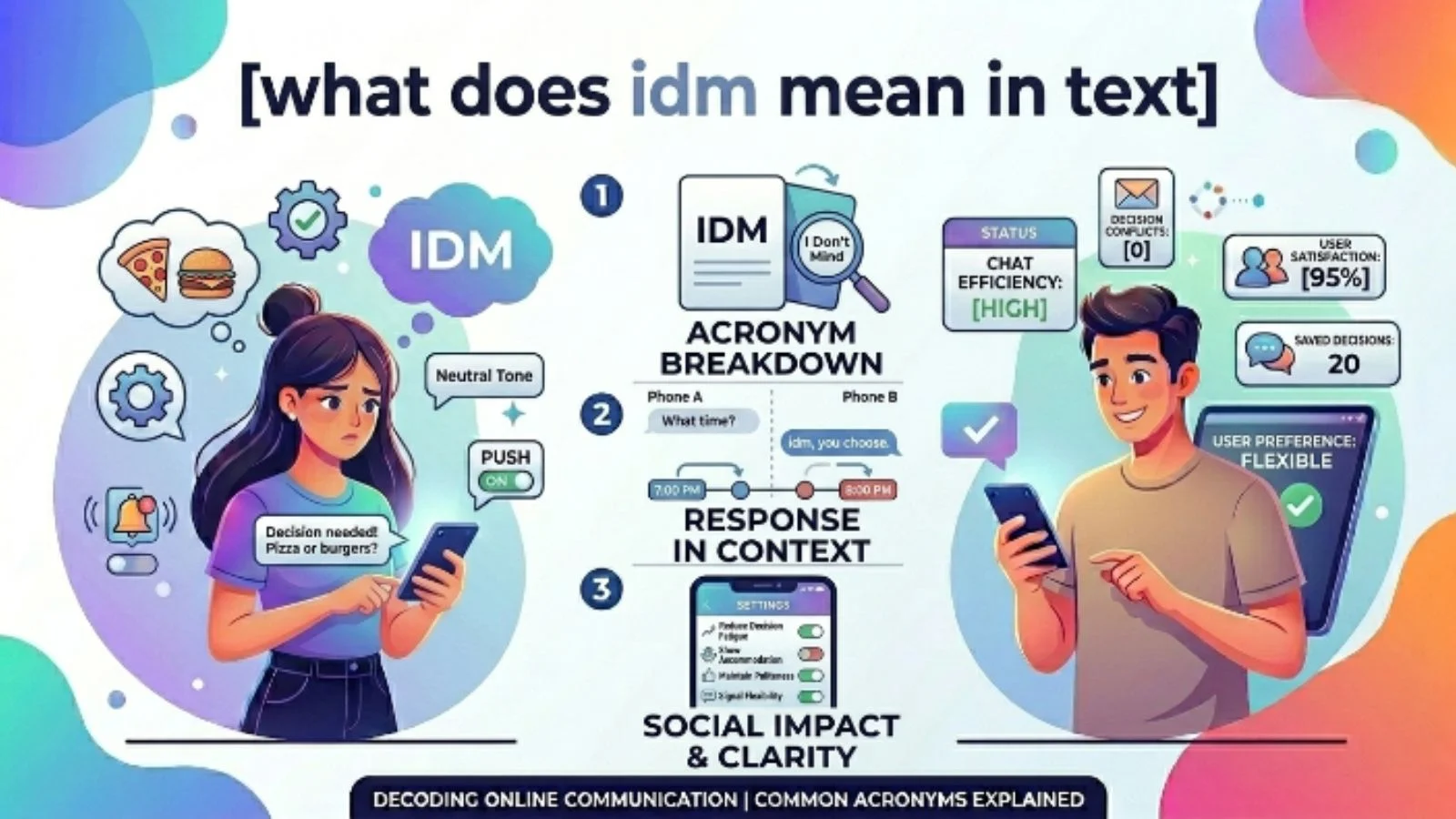
In most texting and social media conversations, IDM means “I Don’t Mind.” It is usually a casual way of saying that you are okay with something, that you have no preference, or that either option is acceptable.
For example:
“Do you want pizza or burgers?”
“IDM.”
Here, IDM means “I don’t mind.” The person is saying they are happy with either choice.
Let’s look at the meaning, examples, usage, and possible misunderstandings in detail.
What Does IDM Mean in Text?
IDM usually means “I Don’t Mind” in text messages and online chats.
It is used when someone wants to say that they are not bothered by something or do not have a strong preference.
For example:
- “IDM where we go.”
- “IDM if you come later.”
- “IDM, you can choose.”
- “IDM either way.”
In each case, the person is communicating flexibility.
Quick Definition
IDM = I Don’t Mind
It generally means:
- I’m okay with it.
- I have no preference.
- Either option is fine.
- It doesn’t bother me.
- You can decide.
The exact feeling depends on the conversation and the sender’s tone.
Simple Meaning of IDM
The easiest way to understand IDM is:
“I’m okay with whatever you choose.”
Imagine your friend asks:
“Should we watch a movie or play a game?”
You answer:
“IDM.”
You are basically saying:
“I don’t mind. You can choose.”
It is a short and convenient response, which is why abbreviations like IDM are common in casual digital conversations.
However, IDM does not always mean that the person is excited about the choice. Sometimes it simply means they do not care strongly enough to choose.
For example:
“Do you want to meet at 5 or 6?”
“IDM.”
This means the person is comfortable with either time.
Where Is IDM Used?
IDM can appear across many casual communication platforms.
You may see it in:
- Text messages
- Snapchat
- Instagram DMs
- Facebook Messenger
- Discord
- TikTok messages
- Online gaming chats
- Group chats
- Casual conversations
It is particularly common when people are making small decisions.
For example:
“What restaurant should we try?”
“IDM, you pick.”
The abbreviation saves time and keeps the conversation relaxed.
Is IDM Used in Formal Communication?
Usually, no.
Although “I don’t mind” is perfectly normal English, the abbreviation IDM is generally better suited to informal communication.
For a professional email, school assignment, business message, or formal conversation, writing “I don’t mind” or “Either option works for me” is clearer.
Why Do People Use IDM?
There are several reasons people use IDM instead of writing the full phrase.
1. It Is Faster
Typing three letters is quicker than writing “I don’t mind.”
This matters when people are having fast-paced conversations.
2. It Sounds Casual
IDM has a relaxed texting style.
For example:
“Where should we sit?”
“IDM, wherever.”
This sounds casual and friendly.
3. It Shows Flexibility
Someone may genuinely not care which option is selected.
Instead of forcing themselves to choose, they can simply say IDM.
4. It Lets Someone Else Decide
Sometimes people use IDM because they want the other person to make the final decision.
For example:
“Pizza or Chinese?”
“IDM, you choose.”
This means the sender is leaving the decision to you.
Real-Life Examples of IDM in Text
Understanding examples is one of the easiest ways to learn internet slang.
Example 1: Choosing a Restaurant
Friend: “Do you want Italian or Mexican food?”
You: “IDM.”
Here, IDM means “I don’t mind.” You are happy with either option.
Example 2: Choosing a Movie
Person A: “Should we watch a comedy or horror movie?”
Person B: “IDM, you pick.”
The person does not have a strong preference and is letting the other person decide.
Example 3: Making Plans
Friend: “Can we meet around 7 instead of 6?”
You: “IDM.”
This means you are okay with changing the meeting time.
Example 4: Group Chat
Friend 1: “Should we play tonight or tomorrow?”
Friend 2: “IDM.”
The person is saying that either day works for them.
Example 5: Sharing Something
Friend: “Do you mind if I bring another friend?”
You: “IDM.”
In this context, the sender is saying that they are not bothered by it.
What Does IDM Mean From a Guy?
If a guy sends you “IDM,” it usually means “I don’t mind.”
For example:
“Do you want me to call you later?”
“IDM.”
The context matters.
It could mean:
- He is okay with either choice.
- He does not have a preference.
- He is leaving the decision to you.
- He is saying something does not bother him.
It does not automatically have a romantic meaning.
If you’re trying to understand his feelings, look at the entire conversation rather than interpreting “IDM” alone.
What Does IDM Mean From a Girl?
If a girl uses IDM in a message, it generally has the same meaning: “I don’t mind.”
For example:
“Want to sit outside or inside?”
“IDM.”
She is saying that either option is acceptable.
Again, the surrounding conversation determines the tone.
IDM vs Similar Texting Terms
Several expressions can look similar to IDM, but they are not always interchangeable.
| Term | Meaning | Typical Use |
|---|---|---|
| IDM | I Don’t Mind | No strong preference |
| IDC | I Don’t Care | Lack of concern or interest |
| IDK | I Don’t Know | Uncertainty |
| LMK | Let Me Know | Asking someone to provide information |
| IK | I Know | Showing awareness |
| NVM | Never Mind | Dropping or correcting a subject |
| IDGAF | I Don’t Give A F*** | Very strong, often rude indifference |
IDM vs IDC
This is one of the most important differences.
IDM usually sounds softer:
“IDM where we eat.”
Meaning:
“Either place is fine with me.”
IDC can sound more dismissive:
“IDC where we eat.”
Depending on the tone, this can sound like:
“I don’t care.”
So if you want to sound polite, IDM is generally safer than IDC.
IDM vs IDK
These abbreviations have completely different meanings.
IDM = I Don’t Mind
IDK = I Don’t Know
For example:
“Do you want tea or coffee?”
“IDM.”
You are okay with either.
But:
“What time does the store close?”
“IDK.”
You do not know the answer.
When Should You Use IDM?
You can use IDM when you genuinely have no strong preference.
Good situations include:
Choosing Between Two Options
“Morning or evening?”
“IDM.”
Making Casual Plans
“Want to meet Friday or Saturday?”
“IDM.”
Responding to a Small Request
“Do you mind if I sit here?”
“IDM.”
Letting Someone Else Decide
“Which movie should we watch?”
“IDM, you choose.”
In all these examples, the abbreviation communicates flexibility.
When Should You Avoid IDM?
Although IDM is useful, it isn’t appropriate everywhere.
Avoid it in:
- Formal emails
- Job applications
- Business proposals
- Academic writing
- Professional reports
- Official correspondence
Instead of:
“IDM.”
You could write:
“Either option works for me.”
Or:
“I don’t have a preference.”
These versions are clearer and more professional.
Common Misunderstandings About IDM
Because text messages don’t include facial expressions or voice tone, IDM can sometimes be misunderstood.
Misunderstanding 1: Thinking IDM Means “I Don’t Care”
While IDM and IDC can sometimes communicate a similar idea, they do not necessarily have the same tone.
IDM generally means:
“I’m fine with it.”
IDC can imply:
“This doesn’t matter to me.”
The difference may be subtle, but it can affect how your message feels.
Misunderstanding 2: Assuming IDM Means the Person Is Excited
IDM usually communicates acceptance, not excitement.
If someone says:
“Want to go shopping?”
And you respond:
“IDM.”
You’re not necessarily saying:
“Yes! That sounds amazing!”
You’re simply saying that you don’t have a problem with the idea.
Misunderstanding 3: Assuming IDM Always Has One Meaning
Abbreviations can have different meanings in different communities.
Although “I Don’t Mind” is a common texting interpretation, context should always be considered.
If the conversation is technical, professional, gaming-related, or related to a particular community, IDM could potentially mean something else.
How to Respond When Someone Says IDM
If someone sends you “IDM,” you usually don’t need a complicated response.
You can simply make the decision yourself.
For example:
“IDM.”
You could reply:
“Okay, let’s do pizza.”
Or:
“Cool, I’ll choose then.”
If you want clarification, ask:
“So either option works for you?”
This is especially useful when the decision is important.
Pro Tips for Using IDM Naturally
If you want your texting style to sound natural, keep a few things in mind.
Use IDM With People You Know
IDM works best in casual conversations with friends, family, classmates, or people you regularly chat with.
Add Context When Necessary
A simple “IDM” can sometimes feel too short.
Instead, you can write:
“IDM, whatever works for you.”
This makes your meaning clearer.
Don’t Use It to Avoid an Important Decision
If someone needs your actual opinion, simply saying IDM may not be helpful.
For example, if a friend asks:
“Should I accept this job?”
Replying “IDM” doesn’t really answer the question.
A better response would be:
“I think you should consider the salary and growth opportunities first.”
Consider Your Tone
Text messages can easily sound colder than intended.
If you want to sound friendly, add a few words:
“IDM, you choose.”
This feels warmer than simply:
“IDM.”
Is IDM Rude?
IDM is generally not rude.
It is normally a neutral and casual abbreviation for “I don’t mind.”
However, tone depends on context.
For example:
“Where do you want to go?”
“IDM.”
This is probably completely normal.
But if someone is asking you about an important personal decision and you repeatedly respond with “IDM,” they might feel that you are not interested in the conversation.
So the abbreviation itself isn’t rude; how and when you use it matters.
Is IDM Still Common in 2026?
Yes, abbreviations remain a common part of informal digital communication, particularly in texting, social media, gaming communities, and private chats.
However, slang changes quickly. Some abbreviations become less popular while others become more common.
That means you should always consider the platform, age group, relationship, and conversation when interpreting a short abbreviation like IDM.
Final Thoughts
So, what does IDM mean in text?
In most casual conversations, IDM means “I Don’t Mind.” It tells someone that you are okay with something, have no strong preference, or are happy to let them make the decision.
For example, if someone asks, “Pizza or burgers?” and you reply, “IDM,” you’re saying that either choice is fine.
Just remember that IDM is different from IDC. IDM usually sounds more relaxed and accepting, while IDC can sometimes sound more dismissive.
When in doubt, look at the surrounding conversation. The context, relationship, and tone will usually tell you exactly what the sender means.
Frequently Asked Questions
1. What does IDM stand for in texting?
IDM stands for “I Don’t Mind.” It is commonly used in casual text messages and online chats to show that someone has no strong preference.
2. Is IDM the same as IDC?
Not exactly. IDM means “I Don’t Mind,” while IDC means “I Don’t Care.” IDM often sounds more accepting, whereas IDC can sound more indifferent or dismissive.
3. What does IDM mean on Snapchat?
On Snapchat, IDM usually means “I Don’t Mind.” Someone may use it when they are comfortable with your suggestion or don’t care which option you choose.
4. Can I use IDM in professional messages?
It is better to avoid the abbreviation in formal communication. Use “I don’t mind,” “Either option works for me,” or “I have no preference” instead.