Have you ever received a text containing “JSP” and stopped for a second because you had no idea what the person meant?
You are not alone. Texting is full of short forms that can have different meanings depending on the conversation, language, and platform. JSP is one of those abbreviations that can be confusing because it does not have just one universal definition.
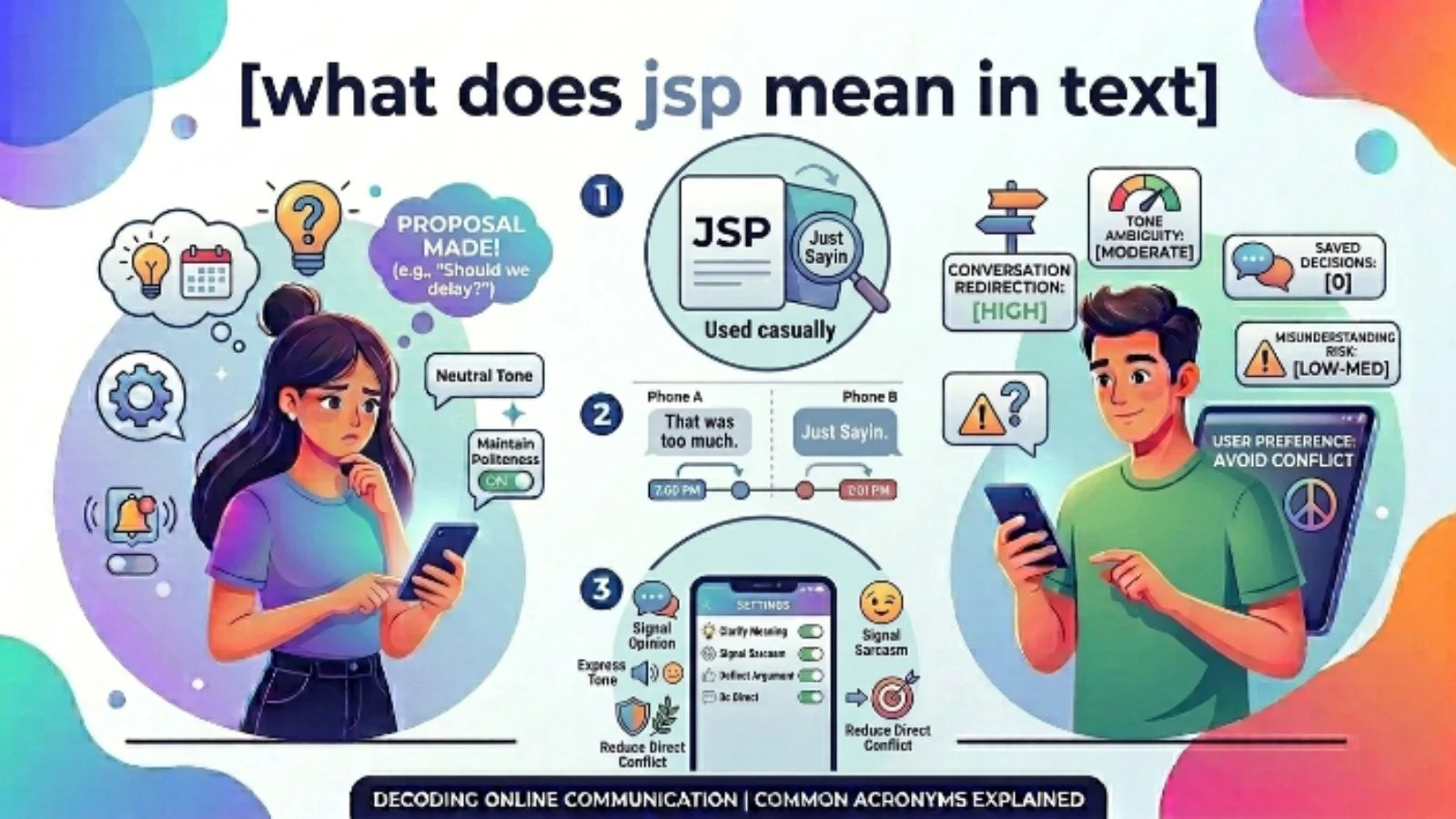
In casual English texting, JSP can mean “Just Playing” or “Just Saying,” depending on the context. In French-language conversations, jsp commonly means “je sais pas,” which translates to “I don’t know.” In technology, JSP has an entirely different meaning: JavaServer Pages.
So, how do you know which meaning someone intended?
The answer is simple: look at the context surrounding JSP. This guide explains the most common meanings, examples, usage, and differences so you can understand it without guessing.
What Does JSP Mean in Text?
In casual texting, JSP can mean “Just Playing” or “Just Saying.” The intended meaning depends on how the person uses it.
When someone uses JSP as “Just Playing,” they are usually telling you that they were joking, teasing, or not being serious.
For example:
“You’re so annoying, jsp.”
Here, JSP can indicate that the person is only teasing and does not genuinely mean the negative statement.
In another conversation, JSP may be used as “Just Saying,” especially after an opinion or observation.
“I think you should talk to her, jsp.”
In this case, the sender is basically saying, “I’m only giving my opinion.”
There is also another important meaning: in French texting, “jsp” stands for “je sais pas,” meaning “I don’t know.” This usage is especially relevant when the conversation is in French.
Quick Definition
JSP in text can mean “Just Playing,” “Just Saying,” or, in French texting, “je sais pas” (“I don’t know”). The surrounding conversation usually tells you which meaning is intended.
JSP Meaning in Simple Words
The easiest way to understand JSP is to consider the sentence around it.
JSP = Just Playing
If someone has just made a joke, sarcastic comment, or playful insult, JSP may mean “Just Playing.”
It is similar to telling someone:
- “I’m joking.”
- “I’m only teasing.”
- “Don’t take that seriously.”
For example:
“You’re officially banned from choosing the movie tonight. JSP.”
The person probably is not actually banning you. They are joking.
JSP = Just Saying
If JSP follows an opinion, suggestion, or observation, it may mean “Just Saying.”
For example:
“That outfit looks better without the jacket, jsp.”
The sender is giving an opinion and indicating that they are simply saying what they think.
JSP = Je Sais Pas
In French internet slang, jsp is short for “je sais pas,” an informal version of “je ne sais pas,” meaning “I don’t know.”
For example:
“Tu viens ce soir?”
“Jsp.”
The response means:
“Are you coming tonight?”
“I don’t know.”
This meaning should not be confused with the English slang interpretations.
Where Is JSP Used?
You may encounter JSP in several types of online conversations.
Text Messages
Friends may use JSP in ordinary SMS or messaging conversations when joking, teasing, or sharing an opinion.
Example:
“You’re buying dinner tonight, jsp.”
The exact meaning depends on the relationship and previous messages.
Snapchat
Short abbreviations are common on Snapchat because conversations are usually quick and informal.
If someone makes a playful comment and adds JSP, “Just Playing” may be intended.
JSP can appear in Instagram DMs, comments, or private conversations.
For example:
“Your old photos were actually better jsp.”
Here, it could be a casual opinion or teasing remark.
TikTok
TikTok comments often use abbreviations in humorous or conversational ways. JSP may appear when someone wants to make a quick statement without writing the full phrase.
WhatsApp and Group Chats
JSP can also appear in WhatsApp conversations, particularly among friends who already understand each other’s texting style.
French-Language Chats
If the entire conversation is in French, jsp is much more likely to mean “je sais pas” (“I don’t know”) than an English slang phrase.
Why Do People Use JSP?
People use abbreviations because they make conversations faster and more casual.
Instead of typing a complete phrase, three letters can communicate the intended idea quickly.
Common reasons include:
- Saving time: Short forms are faster to type.
- Keeping conversations casual: Slang feels more relaxed than formal language.
- Adding tone: JSP can indicate joking, teasing, or casual opinion-sharing.
- Avoiding long explanations: A short abbreviation can be enough when both people understand it.
- Matching online culture: Social media and messaging encourage brief communication.
However, abbreviations can also create confusion when the receiver does not know which meaning is intended.
Real-Life Examples of JSP in Text
The best way to understand JSP is through realistic conversations.
Example 1: JSP as “Just Playing”
Friend: “You are never allowed to cook for us again.”
You: “Wow, okay. I’m offended.”
Friend: “JSP.”
Here, JSP means “Just Playing.” The friend is clarifying that the comment was only a joke.
Example 2: JSP as “Just Saying”
You: “I think you should give him another chance, jsp.”
Here, JSP can mean “Just Saying.”
The person is expressing an opinion without necessarily trying to pressure the other person.
Example 3: A Teasing Comment
Friend: “You seriously spent all your money on shoes? JSP.”
The abbreviation may soften the teasing and suggest that the person is not being completely serious.
Example 4: French Meaning
Person A: “Tu sais où est Sarah?”
Person B: “Jsp.”
In French, this means:
“Do you know where Sarah is?”
“I don’t know.”
Here, JSP clearly means “je sais pas.”
Example 5: Opinion Sharing
Person A: “Do you like the new restaurant?”
Person B: “Honestly, the old one was better jsp.”
In this context, JSP may function as “Just Saying,” showing that the person is simply sharing an opinion.
JSP vs. Similar Texting Terms
JSP can sometimes be confused with other abbreviations. Understanding the differences makes conversations easier to interpret.
| Term | Common Meaning | Typical Use |
|---|---|---|
| JSP | Just Playing / Just Saying | Joking or sharing an opinion |
| JK | Just Kidding | Showing that a previous statement was a joke |
| IDK | I Don’t Know | Saying you do not know something |
| TBH | To Be Honest | Introducing an honest opinion |
| IMO | In My Opinion | Sharing a personal viewpoint |
| LOL | Laughing Out Loud | Showing amusement |
| J/K | Just Kidding | Clarifying that something was not serious |
One important distinction is that JSP is context-dependent, while terms such as IDK and TBH are generally easier to identify.
For example, IDK almost always means “I don’t know” in English texting. JSP can mean different things depending on the conversation.
Is JSP the Same as JK?
Not exactly.
JK means “Just Kidding.”
It is normally used to tell someone that a previous statement was a joke.
JSP, when used as “Just Playing,” can serve a similar purpose, but it is not the same abbreviation.
Compare:
“You’re the worst friend ever. JK.”
This directly means the person is kidding.
Meanwhile:
“I’m never talking to you again. JSP.”
This could mean the person is only playing around.
The two expressions can have similar purposes, but JK is much more widely recognized in English texting.
When Should You Use JSP?
You can use JSP in informal conversations when you are confident the other person will understand it.
It may work well with:
- Close friends
- Family members who use texting slang
- Casual group chats
- Social media conversations
- Gaming chats
- Informal DMs
For example:
“You actually believed me? JSP.”
This works naturally if both people are comfortable with abbreviations.
When Should You Avoid JSP?
Avoid JSP when clarity is more important than casual language.
For example, it is generally better not to use unexplained slang in:
- Job applications
- Professional emails
- Business proposals
- Academic assignments
- Formal customer communication
- Important workplace messages
Instead of writing:
“I think we should change the plan jsp.”
A professional message could say:
“I think we should consider changing the plan.”
Clear language prevents unnecessary confusion.
Common Misunderstandings About JSP
1. Assuming JSP Has Only One Meaning
This is the biggest mistake.
JSP does not have one meaning in every conversation. Context matters.
2. Automatically Assuming It Means “Just Playing”
Some English-language slang sources use JSP for “Just Playing,” while others use it for “Just Saying.” French speakers may use it for “je sais pas.”
Therefore, you should read the entire message before deciding what the sender means.
3. Confusing It With a Technical Term
In programming, JSP can refer to JavaServer Pages, a web technology.
So if someone says:
“The JSP page isn’t rendering correctly.”
They are almost certainly talking about programming, not texting slang.
4. Ignoring the Language of the Conversation
If the conversation is written in French, jsp probably means “je sais pas.”
If the conversation is in English, an informal slang interpretation may be more likely.
How to Figure Out What JSP Means
If someone sends you JSP and you are unsure, use these clues.
Look at the Sentence
Ask yourself:
Is the person joking?
If yes, “Just Playing” could fit.
Are they giving an opinion?
If yes, “Just Saying” may make sense.
Is the conversation in French?
If yes, “je sais pas” is a strong possibility.
Look at What Came Before It
The previous sentence often gives you the answer.
For example:
“I hate your new haircut. JSP.”
The playful context suggests that the sender may be teasing.
But:
“I don’t think that plan will work, jsp.”
This is more likely to function as a casual opinion.
Consider Who Sent It
A French-speaking friend, an English-speaking friend, a gamer, and a programmer may all use JSP differently.
The sender’s background and the subject of the conversation can be important clues.
Pro Tips for Understanding JSP
When you see JSP in a message, do not immediately assume its meaning.
Instead:
- Read the complete conversation.
- Check the language being used.
- Look for joking or teasing.
- Consider whether the sender is sharing an opinion.
- Think about the topic of the conversation.
- Ask politely if the meaning is still unclear.
A simple response such as “What do you mean by JSP?” is perfectly reasonable if the context does not make it obvious.
It is much better to ask than to respond based on the wrong interpretation.
Why Context Matters So Much With Texting Slang
Text messages do not include the same facial expressions, voice tone, or body language that people use during face-to-face conversations.
That makes short abbreviations especially tricky.
Consider this message:
“You’re ridiculous jsp.”
Depending on the relationship, it could be affectionate teasing, genuine criticism, or an informal opinion.
The abbreviation alone cannot tell you everything.
This is why understanding tone, context, and the relationship between the people texting is often more useful than memorizing a single definition.
Frequently Asked Questions
What does JSP mean in text?
JSP can mean “Just Playing” or “Just Saying” in casual English texting. In French texting, jsp commonly means “je sais pas,” or “I don’t know.” The correct meaning depends on context.
What does JSP mean on Snapchat?
On Snapchat, JSP may be used as informal slang, particularly after a joke, tease, or opinion. “Just Playing” is one possible interpretation, while “Just Saying” may also fit depending on the message.
Is JSP the same as JK?
No. JK means “Just Kidding,” while JSP may mean “Just Playing” or “Just Saying.” They can have similar functions when JSP is being used to indicate that someone is joking.
What does JSP mean in French texting?
In French texting, jsp means “je sais pas,” an informal abbreviation meaning “I don’t know.” This is a common interpretation when the surrounding conversation is in French.
Can JSP mean something outside texting?
Yes. In technology, JSP commonly refers to JavaServer Pages, which is unrelated to internet slang. The subject of the conversation usually makes the intended meaning clear.
Final Thoughts
So, what does JSP mean in text? The short answer is that it depends on context.
In casual English conversations, JSP can mean “Just Playing” when someone is joking or teasing, or “Just Saying” when someone is casually expressing an opinion. In French texting, jsp means “je sais pas,” or “I don’t know.”
The safest way to understand JSP is to look at the entire message rather than focusing only on the three letters.
If the sender is joking, think “Just Playing.” If they are making a casual comment, “Just Saying” may fit. If the conversation is in French, “je sais pas” is likely.
Once you pay attention to the surrounding words and tone, JSP becomes much easier to understand.