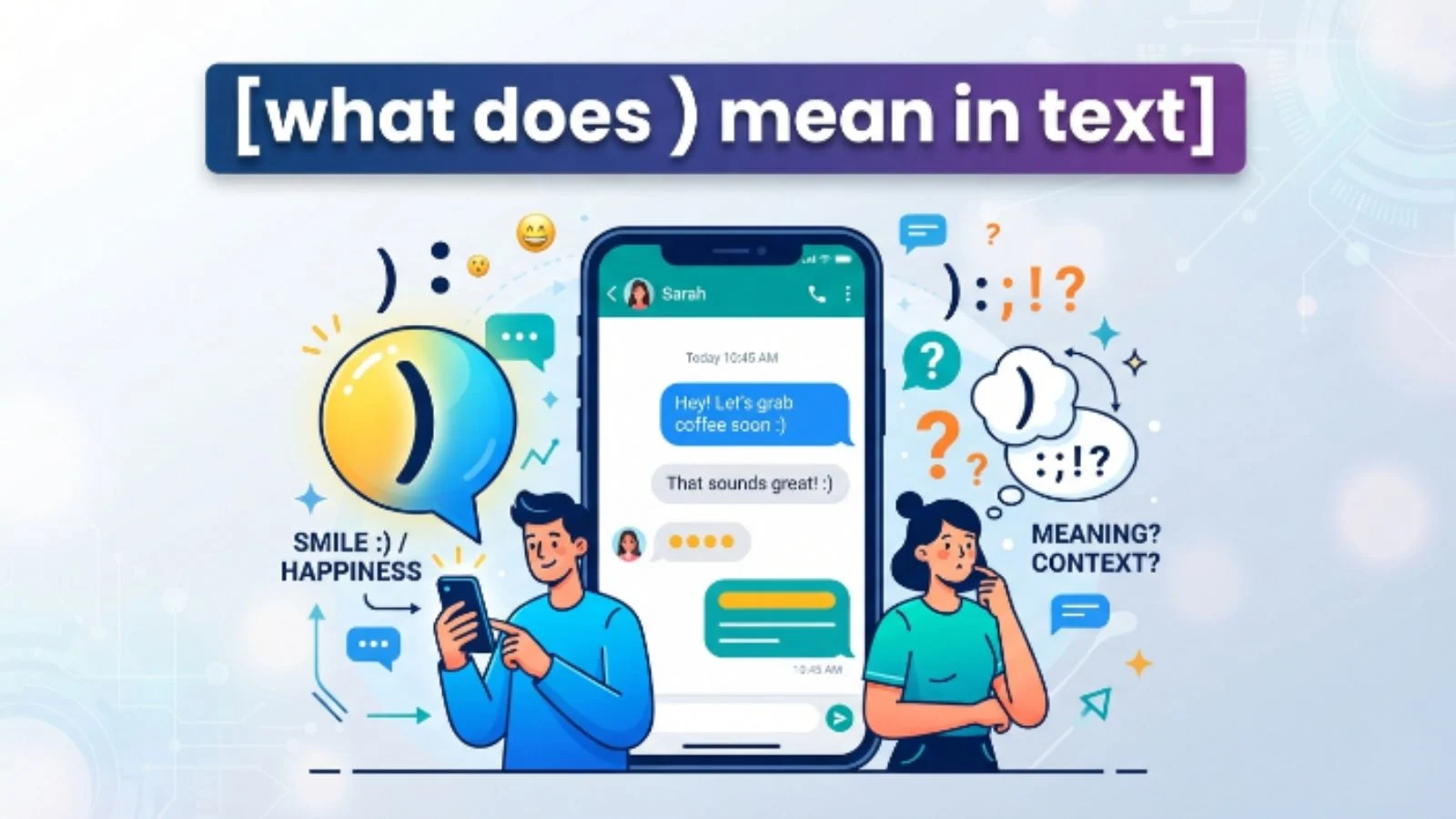
Have you ever received a text that ends with a single “)“ and wondered what the person actually meant?
A message like “Okay )”, “See you later )”, or simply “)“ can look confusing, especially if you are used to modern emojis and texting slang. Is it a smile? A typo? A secret code? Or does it have a completely different meaning?
The answer depends heavily on the context, the person sending it, and the conversation. In many cases, the symbol “)“ is used as a shortened or incomplete smiley face. It can make a message sound friendly, warm, or slightly playful.
However, there are also other possible meanings. In this guide, you will learn exactly what does ) mean in text, how people use it, what it can communicate, and how to understand it correctly.
What Does ) Mean in Text?
In texting, “)“ usually represents a smile or a friendly emotional tone. It is often used as a shortened version of a traditional smiley face such as 🙂.
For example:
“Thanks for helping me )”
This usually means:
“Thanks for helping me :)”
The person may be trying to sound friendly, positive, or appreciative.
The meaning can change depending on the message. Sometimes **“)“ can make a sentence feel softer, while in other situations it may simply be a typing style used by a particular person.
Simple Meaning of )
The simplest meaning of **“)“ in text is:
A small smile, friendliness, warmth, or a positive tone.
It can be similar to:
- 🙂
- ☺
- 🙂
- A small friendly smile
However, the symbol “)“ by itself is not always a complete emoticon. Traditionally, a smiley face is written as 🙂, where the colon represents the eyes and the closing parenthesis represents the smiling mouth.
Some people use only the closing parenthesis because it is quicker, more subtle, or part of their personal texting style.
Example
Person A: Thanks for the advice )
Person B: No problem!
Here, the **“)“ makes the message feel warmer and friendlier.
Without it, the message would simply be:
“Thanks for the advice.”
With the symbol, the message may feel more relaxed and positive.
What Does ) Mean When Someone Sends It Alone?
If someone sends only:
)
The meaning can be unclear.
It may mean:
- A simple smile
- A friendly reaction
- A shortened smiley face
- A playful response
- An accidental message
The surrounding conversation is extremely important.
Example 1: Friendly Meaning
You: I finally finished my work.
Them: )
In this situation, the person may be responding with a small smile or positive reaction.
Example 2: Playful Meaning
You: I know you secretly enjoyed that movie.
Them: )
Here, the symbol might suggest a playful or slightly teasing smile.
Example 3: Possible Typing Mistake
You: Are you coming tonight?
Them: )
If the message seems completely unrelated, the person may have accidentally sent the symbol.
The best way to understand it is to look at the conversation before and after the symbol.
Why Do People Use ) in Text Messages?
People use **“)“ for several different reasons. The meaning is often more about emotional tone than a fixed definition.
1. To Sound Friendly
Text messages can sometimes sound cold because they do not include facial expressions or voice tone.
Compare:
“Okay.”
with:
“Okay )”
The second version may feel more relaxed and friendly.
2. To Add a Small Smile
Some people use **“)“ as a minimalist smile. They may not want to use a full emoji but still want to show a positive mood.
For example:
“Good night )”
This may simply mean:
“Good night :)”
3. To Soften a Message
A short message can sometimes sound harsh.
For example:
“You are late.”
This sounds direct and possibly annoyed.
But:
“You are late )”
may sound more playful, depending on the relationship between the people.
4. Because It Is Their Personal Style
Some people develop their own texting habits. They may use a particular symbol after many messages.
For example:
- Hello )
- Thanks )
- Good morning )
- See you later )
For that person, **“)“ may simply be their regular way of adding warmth to messages.
Where Is ) Used?
The symbol **“)“ can appear in many digital conversations, including:
- Text messages
- Facebook Messenger
- Instagram direct messages
- Snapchat chats
- Telegram
- Online forums
- Gaming chats
- Dating apps
- Comments and private messages
Its meaning does not usually depend on one specific platform. Instead, it depends more on the sender’s communication style and the context.
Someone who uses **“)“ regularly may use it the same way another person uses a smile emoji.
Real-Life Examples of ) in Text
Understanding examples is one of the easiest ways to understand this symbol.
Example 1: Showing Appreciation
Message:
Thanks for helping me with that )
Meaning:
The sender is probably expressing gratitude in a friendly and warm way.
The closing parenthesis acts like a small smile.
Example 2: Ending a Friendly Conversation
Message:
See you tomorrow )
Meaning:
The person is likely ending the conversation positively.
It can make the message feel more relaxed than simply saying:
See you tomorrow.
Example 3: Responding Playfully
Person A: You definitely missed me.
Person B: Maybe )
Meaning:
Here, **“)“ may suggest a playful or teasing tone.
The sender may be joking rather than giving a serious answer.
Example 4: A Positive Response
Person A: Everything is ready for the event.
Person B: Great )
Meaning:
The symbol adds a little friendliness to the response.
Example 5: A Short Greeting
Message:
Hey )
Meaning:
This can be a casual and friendly greeting.
Depending on the relationship, it may simply mean:
“Hey, I am being friendly.”
) vs 🙂 vs 🙂: What Is the Difference?
Although these symbols can communicate a similar feeling, they are not exactly the same.
| Symbol | Common Meaning | Typical Tone |
|---|---|---|
| ) | Small smile or friendly tone | Subtle and minimalist |
| 🙂 | Traditional smiley face | Friendly and positive |
| 🙂 | Smiling emoji | Clear and modern |
| 😊 | Warm, happy smile | More expressive and affectionate |
The Difference in Feeling
Consider these messages:
“Thanks )”
“Thanks :)”
“Thanks 🙂”
“Thanks 😊”
All of them can express appreciation, but the emotional intensity may feel different.
**“)“ is usually the most subtle. It may be a quiet smile rather than an obvious emotional reaction.
Can ) Have a Negative Meaning?
Yes, sometimes.
Not every use of **“)“ is positive. In some contexts, it may be used sarcastically or passive-aggressively.
For example:
“Sure, do whatever you want )”
Depending on the conversation, this might not be a genuine smile. The person could actually be annoyed.
Similarly:
“No problem )”
could be friendly, or it could sound sarcastic if the previous conversation involved an argument.
This is why you should never interpret the symbol completely on its own.
Pay Attention to the Words
The words surrounding the symbol usually reveal the real meaning.
Friendly:
Thanks for understanding )
Possibly sarcastic:
Yeah, that was really helpful )
The same symbol can communicate different emotions depending on the situation.
What Does ) Mean From a Girl or Guy?
There is no universal gender-specific meaning for **“)“.
If a girl sends:
Good night )
it does not automatically mean she is flirting.
If a guy sends:
See you later )
it does not automatically mean he is romantically interested.
The symbol usually indicates a friendly, positive, playful, or casual tone.
To understand whether there is a romantic meaning, you need to consider the entire conversation, including:
- The words being used
- How often the person contacts you
- The relationship between you
- Other emojis or symbols
- The overall tone of the conversation
One closing parenthesis alone is not enough to prove romantic interest.
What Does ) Mean in a Conversation?
The meaning of **“)“ can change based on where it appears.
At the End of a Greeting
“Hi )”
Usually sounds friendly and casual.
After a Thank-You
“Thanks )”
Usually communicates appreciation with a warm tone.
After a Joke
“I knew you would say that )”
May suggest amusement or playful teasing.
After a Short Answer
“Maybe )”
May sound playful, mysterious, or teasing.
After a Serious Statement
“Fine, do what you want )”
Could potentially sound sarcastic or passive-aggressive.
Context matters more than the symbol itself.
Common Misunderstandings About )
Many people misunderstand this symbol because it is not used exactly the same way by everyone.
Misunderstanding 1: It Always Means Flirting
This is not true.
A person may use **“)“ with friends, family, coworkers, or anyone else.
It can simply be a personal texting habit.
Misunderstanding 2: It Always Means Sarcasm
This is also incorrect.
Although **“)“ can sometimes be sarcastic, its most common use is often a small smile or friendly tone.
Misunderstanding 3: It Is Always a Typo
Not necessarily.
Some people intentionally use a single closing parenthesis as a smile.
Misunderstanding 4: It Has One Fixed Meaning
Texting symbols are highly dependent on context.
The same **“)“ can mean friendliness in one message and sarcasm in another.
When Should You Use )?
You can use **“)“ when you want to add a subtle, friendly tone to a casual message.
It may work well in messages such as:
- Thanks )
- Good morning )
- See you soon )
- That sounds good )
- No worries )
It is especially suitable when you are chatting with someone who already uses the symbol.
A Helpful Tip
If the other person regularly uses **“)“ in their messages, using it back may feel natural.
However, if you are writing a professional email, formal business message, or serious communication, it is usually better to avoid unexplained texting symbols.
When Should You Avoid Using )?
You may want to avoid using **“)“ in situations where your tone needs to be completely clear.
For example:
- Formal work emails
- Job applications
- Official complaints
- Serious apologies
- Legal or professional communication
A single symbol can sometimes be misunderstood.
For professional writing, clear words are usually better than relying on a symbol to communicate emotion.
Pro Tips for Understanding )
Here are some practical tips to help you understand this symbol correctly.
Look at the Full Message
Never interpret **“)“ without reading the rest of the conversation.
The words around it provide the real context.
Consider the Person’s Usual Style
Does the person use **“)“ after nearly every message?
If so, it may simply be their personal texting habit.
Pay Attention to the Conversation’s Mood
Was the conversation friendly, romantic, funny, or argumentative?
The emotional situation can completely change the meaning.
Do Not Overanalyze One Symbol
One **“)“ does not automatically reveal someone’s feelings.
Look for patterns in communication instead of focusing on a single punctuation mark.
Ask If You Are Truly Confused
If the meaning seems unclear, you can simply ask:
“What did you mean by the )?”
In most casual conversations, the person will explain.
Frequently Asked Questions
What does ) mean in text?
In text messages, **“)“ commonly represents a small smile or friendly tone. It is often used as a shortened version of 🙂. However, the exact meaning depends on the conversation and the sender’s personal texting style.
Is ) the same as a smiley face?
Not exactly, but it can serve a similar purpose. A traditional smiley face is 🙂, while some people use only **“)“ as a shorter and more subtle version.
Does ) mean someone is flirting?
Not necessarily. **“)“ can be friendly, playful, or casual. It does not automatically indicate flirting or romantic interest. The meaning depends on the complete conversation and relationship.
Can ) be sarcastic?
Yes. In certain contexts, **“)“ may be sarcastic or passive-aggressive. For example, “Sure, no problem )” could sound different depending on whether the conversation is friendly or tense.
Final Thoughts
So, what does ) mean in text? In most cases, it represents a small smile, friendliness, warmth, or a positive tone. Many people use it as a shorter and more subtle version of 🙂.
However, context is everything. A single **“)“ can be friendly, playful, sarcastic, or simply part of someone’s usual texting style.
The best way to understand it is to consider the full message, the conversation’s mood, and the sender’s normal communication habits. Do not assume that one symbol automatically reveals someone’s feelings.
When used naturally, **“)“ is simply a small digital expression that can make a text feel more relaxed and friendly.